
Applications
High-Drain Packs for Power Tools
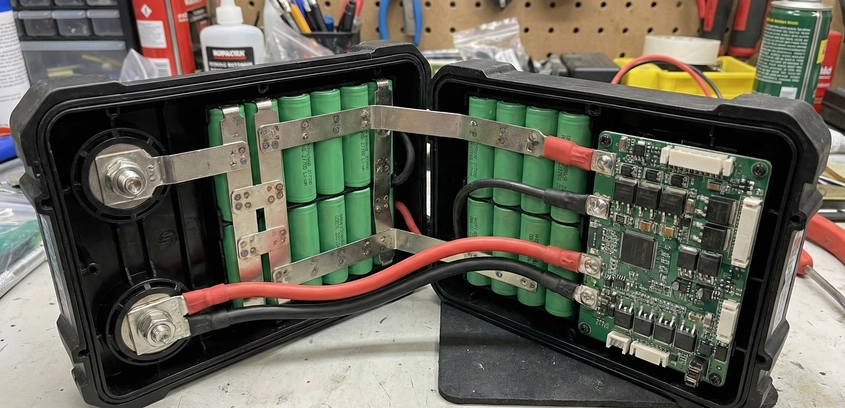
The Difference Between Energy and PowerIn the DIY battery world, there is a dangerous misconception that "a battery is a battery." Beginners often crack open old laptop packs, harvest the cells, and try to use them to rebuild a dead drill battery. The result is almost always the same: the drill works for 3 seconds, then stalls, smokes, or refuses to charge.This failure happens because of the fundamental difference between Energy Cells (Laptop/Flashlight) and Power Cells (Power Tools/Vapes). A circular saw cutting through wet lumber does not sip power; it gulps it. The "Inrush Current" (the spike when you pull the trigger) can exceed 80 Amps. Standard cells have high internal resistance and cannot deliver this current without massive voltage sag. In this guide, we will explore the materials science of high-drain cells and the robust assembly techniques required to build a tool pack that outperforms the factory original.1. The Physics of the Stall CurrentElectric motors draw maximum current when they are stopped (0 RPM). When your drill bit gets stuck in a knot of wood, the motor acts as a near-short circuit. The Math: An 18V tool motor might have a winding resistance of 0.2 Ohms. $$I = V / R = 18V / 0.2Omega = 90 Amps$$ While the tool's internal controller might limit this to 40A or 50A, the battery must be capable of delivering that burst without collapsing. If you use a laptop cell rated for 5A, its voltage will instantly drop below the BMS cutoff (e.g., from 4.2V to 2.5V), and the tool will shut down to protect the cells.2. Cell Selection: The Holy Trinity of PowerYou cannot buy cells based on mAh capacity alone. In fact, for power tools, lower capacity often means higher power. (See our guide on C-Ratings to understand why). Here are the cells you should be using for a professional rebuild:18650 Form FactorSony / Murata VTC5A or VTC6: The VTC5A (2600mAh) is legendary for its 35A discharge capability. It runs cool under extreme loads.Samsung 25S: Specifically designed for tools. It sacrifices capacity (2500mAh) for an incredibly "stiff" voltage curve that keeps torque high.Molicel P26A / P28A: The current king of value and performance. 35A continuous rating with excellent thermal management.21700 Form Factor (For newer packs)Samsung 30T / 40T: The 30T is a monster capable of 35A+ continuous. The 40T offers a balance of 4000mAh and 35A.Molicel P42A / P45B: The P45B is currently the best power cell on Earth, capable of 45A continuous and 100A bursts.The Trap: Do not use the Samsung 35E or Panasonic NCR18650B. These are 8A-10A cells. They will overheat and die in a power tool.3. The Nickel BottleneckIn a low-power solar bank, 0.15mm nickel strip is fine. In a tool pack, 0.15mm nickel is a fuse. pushing 40 Amps through a standard nickel strip will turn it red hot. The resistance of the strip causes voltage drop, robbing your tool of power.The Protocol for High Current: 1. Use 0.20mm Pure Nickel: It is harder to weld (requires a powerful Spot Welder), but handles 50% more current than 0.15mm. 2. Series Stacking: Do not rely on a single layer. Weld one strip, then weld a second strip directly on top of it. This doubles the cross-sectional area and halves the resistance. 3. The "Ladder" Mod: Some builders solder heavy copper braid onto the nickel series connections to provide a super-highway for electrons.4. Vibration and Impact ResistancePower tool batteries live a hard life. They are dropped, shaken, and hammered. Factory Design: Open a Milwaukee or DeWalt pack. You will see the cells are held in a rigid plastic chassis (Cell Holder) that floats inside the outer rubberized shell. The nickel strips are often bent in specific shapes to act as springs. DIY Rebuild: - Never glue cells together without a holder. The glue will crack under impact. - Use Fishpaper Rings on every positive terminal. Vibration wears through PVC shrink wrap quickly. - Potting: For extreme durability, inject neutral-cure silicone between the cells and the case walls to act as a shock absorber.5. The BMS and Proprietary BoardsMost power tool batteries have the BMS integrated into the tool communication. The board inside the battery might just be a balancing and protection circuit that talks to the drill. Reusing the PCB: When rebuilding, you usually must reuse the original PCB (Circuit Board). The Danger: Many tool BMS boards have a "Bricking" feature. If they lose voltage (because you disconnected the old cells), they permanently lock themselves to prevent tampering. The Trick: Connect a temporary 18V power supply to the BMS voltage input points before cutting the old cells. Keep the board energized while you swap the pack. This is advanced surgery.6. Charging SafetyBecause you are using high-performance cells, your new pack might charge faster or get hotter than the old one. - Thermistors: You MUST transfer the temperature sensors (NTC) from the old pack to the new one. Tape them securely to the middle of the cell cluster. The charger relies on this probe to stop charging if the pack gets hot. Without it, the charger might melt your new pack.SummaryRebuilding a power tool battery is one of the most cost-effective DIY projects. For $40 in cells, you can build a pack that outperforms a $150 factory replacement. However, it demands respect for amperage. You are building a device designed to dump energy as fast as possible. Use Molicel or Samsung high-drain cells, double your nickel strips, and never skimp on insulation. Your wrist will feel the difference in torque immediately.