Latest Articles

Page 5 of 10
Top Balancing Large Prismatic LiFePO4 Banks Solar Systems

Top Balancing Large Prismatic LiFePO4 Banks

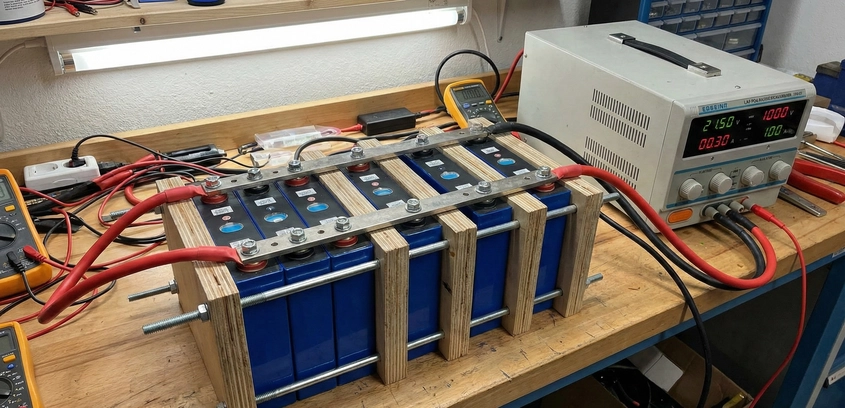
The Myth of the Factory Balanced CellYou have just received a heavy wooden crate containing sixteen 280Ah LiFePO4 prismatic cells. You measure them with a high-precision multimeter, and they all read exactly 3.29V. You might think, "Perfect, they are identical, I can build my 48V pack now." If you do this, you are making a fundamental error that will limit your battery capacity and frustrate you for months to come.Voltage, especially in the middle of the Lithium Iron Phosphate discharge curve, is an incredibly poor indicator of State of Charge (SOC). Because LFP has a famously flat voltage profile, two cells at 3.29V could actually be 20% apart in their actual energy content. One could be at 40% SOC, and the other at 60%. When you connect them in series, this minor discrepancy becomes a massive operational wall. This guide explores the chemistry and the rigorous procedure of Top Balancing—the non-negotiable process of synchronizing cells at their upper saturation point before assembly.1. Why Series Balancing is Not EnoughMost beginners believe that a BMS with balancing will eventually fix the pack. This is mathematically impossible for large banks. A standard passive BMS bleeds off energy at 30mA to 50mA. In a 280Ah pack, a 10% SOC difference is 28 Amp-hours. The Math: $28Ah / 0.050A = mathbf{560 hours}$ of continuous balancing. The BMS only balances when the battery is at the very top of the charge (the "Knee"). Since your charger only stays at that voltage for 30-60 minutes a day, it would take over a year of daily cycles for the BMS to fix a 10% drift. During that year, the high cell will constantly trip the Over-Voltage Protection, cutting off the charger and leaving the rest of your pack undercharged. You effectively "lose" a huge chunk of the battery you paid for.2. The "Knee" of the LFP CurveTo understand top balancing, you must understand the LFP voltage curve. From 20% to 80% SOC, the voltage stays around 3.2V to 3.3V. However, as the cell reaches 95% SOC, the voltage "hits the knee" and shoots up rapidly toward 3.65V. Top balancing ensures that every cell hits this knee at the exact same microsecond. If they aren't balanced, one cell will rocket to 3.65V while the others are still lagging at 3.40V. The BMS sees the "runner" cell hitting the safety limit and shuts down the charge, even though the total pack energy is far from full.3. The Parallel Saturation Method: Step-by-StepThis is the industry-standard method for DIY builders. It involves turning all your cells into one giant 3.2V cell so they have no choice but to equalize.Step 1: The Initial Series Charge (Optional but Recommended)Charging 16 large cells in parallel from 30% to 100% using a small lab power supply can take two weeks. To speed this up, assemble the pack in its final 16S (48V) configuration with a BMS. Charge the pack until the first cell hits 3.50V. Stop the charge. The pack is now roughly 95% full.Step 2: The Parallel TransitionDisassemble the series connections. Lay your cells side-by-side. Use copper busbars to connect all Positives together and all Negatives together. CRITICAL WARNING: Before connecting the last busbar, verify cell voltages. If one cell is at 3.2V and another at 3.5V, a massive current will rush between them. If the difference is >0.1V, use a resistor to bleed the high cell down before making the solid parallel connection.Step 3: The Lab Power Supply SetupYou need a high-quality, adjustable power supply (like an RD6006). 1. Set the voltage to 3.650V exactly. Use a calibrated multimeter to verify the supply's screen is accurate. 2. Set current to maximum (e.g., 10A or 20A). 3. Connect to the giant parallel block.Step 4: The Soak PhaseThe power supply will stay in "Constant Current" (CC) mode for a long time. Eventually, the voltage will hit 3.65V, and the supply will switch to "Constant Voltage" (CV). The amperage will start to drop. When are you done? You are finished when the current drops to near zero (e.g., < 0.5A for the whole block). This indicates that the chemical potential of the cells is perfectly matched to the 3.65V source. The anode is fully saturated across all cells.4. Common Traps: Surface Charge and ResistanceA common mistake is stopping when the voltage hits 3.65V. If you disconnect the charger while it is still pushing 5 Amps, the voltage will instantly "settle" or drop back to 3.4V. This is called Surface Charge. To have a true balance, you must hold the voltage until the chemical reaction is complete and no more current can be accepted.Also, beware of Busbar Resistance. If your power supply is connected to Cell #1, and you have 16 cells in a row, the resistance of the busbars might mean Cell #16 is seeing 3.60V while the supply reads 3.65V. Solution: Connect the Positive lead of the charger to one end of the block, and the Negative lead to the opposite end. This ensures an equal path length for all cells.5. After the Balance: The Rest PeriodOnce balancing is done, disconnect the power supply but leave the cells in parallel for another 24 hours. This allows any micro-variations in internal resistance to settle. After 24 hours, measure the voltages. They should be identical to the third decimal place. Now, you can safely reassemble them into your 48V series pack, knowing that your BMS will only have to deal with minor maintenance balancing rather than a 30Ah drift.SummaryTop balancing is a test of patience. It feels like "dead time" when you are excited to finish your solar build, but it is the foundation of system health. A pack that is not top-balanced will never deliver its full rated Watt-hours and will cause constant BMS nuisance trips. (See LiFePO4 vs Li-Ion for more on why this chemistry requires specific care). Do it once, do it right, and your battery bank will serve you for the next decade without drama.

07 Nov 2025 Read More
Server Rack Batteries vs. DIY Builds Solar Systems

Server Rack Batteries vs. DIY Builds

The End of the DIY Golden Age?In 2018, the decision was simple. If you wanted a 5kWh LiFePO4 battery, you could either pay $3,500 for a commercial unit or spend $1,200 building it yourself from AliExpress cells. The 300% savings made the risk of "DIY" a no-brainer for any enthusiast with a spot welder. However, as we enter 2026, the market has transformed. Companies like EG4, SOK, and Pylontech have brought the "Server Rack" format (19-inch rack mountable blocks) to the masses at prices that were unimaginable five years ago.Today, a DIY builder must ask: "Is my time and the inherent risk worth the $200 I might save?" In this guide, we will break down the true costs, the insurance implications, and the hidden technical trade-offs of both approaches to help you decide if you should be turning a wrench or clicking "Add to Cart."1. The Cold Hard Math: Cost per Kilowatt-HourLet's look at a 48V 100Ah (5.12kWh) baseline comparison in today's market.The DIY Build Estimate16x 100Ah Prismatic Cells (Grade B): ~$550 - $650 (including shipping).Smart BMS (JK/Seplos): ~$120.Steel Case/Box + Busbars + Wires: ~$150.Consumables (Insulation, tape, lugs): ~$50.Total Parts: ~$870 - $970.Labor: 15-20 hours (Research, testing, assembly).The Server Rack AlternativePre-built 100Ah Rack Battery (e.g., EG4-LL or SOK): ~$1,200 - $1,400.Warranty: 10 years.Shipping: Usually included or flat rate.The Gap: You are saving roughly $300 to $400 per battery. On a small 10kWh system, that's $800. On a large 30kWh system, you save $2,400. This is still a significant amount of money, but it is no longer the 300% difference of the past. You must decide if your labor is worth ~$20 per hour.2. Certification and Insurance: The Hidden DealbreakerThis is the most critical factor for homeowners. In many jurisdictions (especially the US, Canada, and parts of Europe), installing energy storage requires a permit. To get a permit, your equipment must be UL 1973 (Battery) and UL 9540 (System) certified.Server Rack Batteries: Most reputable brands carry these certifications. If your house burns down (even from a non-battery cause), your insurance company has no ground to deny the claim because your energy system was code-compliant.DIY Packs: A DIY pack will never be UL certified. In the eyes of an insurance adjuster, it is an "unlisted high-voltage appliance." Using a DIY battery in a grid-interactive home system is an immense legal and financial risk.Verdict: If you are building for a registered home system, Buy the Server Rack. If you are building for an off-grid cabin, an RV, or a workshop shed where permits aren't an issue, DIY remains viable.3. Technical Edge: Why DIY Can Be BetterDespite the cost and certification issues, a DIY build can actually be superior in performance to a mass-produced rack battery if built correctly.Active vs. Passive BalancingMost server rack batteries use cheap passive balancers (30mA - 50mA). Over years of use, these struggle to keep up with cell drift. A DIY builder can install a 2A Active Balancer which keeps the cells perfectly synchronized 24/7. This can lead to a longer actual lifespan for the pack.Component QualityWhen you build it, you choose the MOSFETs. You choose the gauge of the internal wiring. Most server rack batteries use thin 10 AWG or 8 AWG internal leads. A DIY builder can use 4 AWG and oversized copper busbars to minimize internal voltage drop and heat. (See our Busbar Design Masterclass).RepairabilityIf a single cell fails in a sealed server rack battery, the whole unit is often considered "hazardous waste" by the manufacturer. If you built it, you simply unbolt the busbars, swap the one bad cell, and you are back in business for $50. In a world of planned obsolescence, DIY is the only "Right to Repair" option.4. Form Factor and CustomizationServer rack batteries are built for one thing: 19-inch server racks. They are heavy, deep, and industrial. What if you need to fit 10kWh under the seat of a Van? What if you want to build a "slim-line" battery that sits behind a sofa? DIY allows you to use Grade A Prismatic Cells in any orientation (though always terminals up) and any physical footprint. This architectural freedom is why the "Van Life" and "Boating" communities still heavily favor DIY builds.5. The Quality Control GambleWhen you buy a server rack battery, you are paying for the factory's QC. They top-balance the cells, check internal resistance, and stress-test the BMS. When you buy raw cells from a grey-market vendor (AliExpress/Alibaba), you might get Grade B Rejects. You might spend a week top-balancing cells only to find that one cell has a high self-discharge rate. For a beginner, this troubleshooting process is steep and frustrating. You need specialized tools (YR1035+, EBC-A40L) which add another $200 to your "DIY" cost.The Final Decision MatrixFeatureDIY BuildServer Rack BatteryUpfront CostLowest (~$170/kWh)Competitive (~$240/kWh)CertificationNoneUL 1973 / UL 9540WarrantyNone (Manufacturer only)10-Year Full ReplacementComplexityHigh (Requires tools/skill)None (Plug and Play)ServiceabilityTotal (Every part is swappable)Poor (Void warranty to open)SafetyDependent on your skillFactory Tested / EnclosedAs of 2026, building your own battery bank has moved from a "frugal necessity" to a "high-performance hobby." If you enjoy the engineering, want the highest quality components (Active balancers, oversized busbars), and are using it in an application where UL listing isn't required, DIY is incredibly rewarding. But for the average homeowner looking for reliable, insured solar storage, the "Server Rack" battery has won the war of economics.

06 Nov 2025 Read More
Interfacing Batteries with Hybrid Inverters Solar Systems

Interfacing Batteries with Hybrid Inverters

The Energy Management BridgeIn a modern solar installation, the hybrid inverter is the central processor, but the battery bank is the lifeblood. Connecting these two components is more than just running thick 4/0 AWG cables; it involves establishing a data-driven relationship that dictates how energy is harvested, stored, and deployed. For the DIY builder, this stage is where technical theory meets hardware reality. If the inverter doesn't understand the battery's State of Charge (SOC) or internal temperature, it will treat the lithium bank like a dumb lead-acid block, leading to inefficient charging and premature cell degradation.This guide explores the architectural nuances of connecting Lithium Iron Phosphate (LiFePO4) banks to industry-standard hybrid inverters. We will look at why communication is the "holy grail" of solar storage and how to manually configure systems when data lines aren't an option.1. Open-Loop vs. Closed-Loop SystemsBefore plugging in any cables, you must decide which control philosophy your system will use.Open-Loop (Voltage-Based Control)In an Open-Loop configuration, there is no data cable between the Battery Management System (BMS) and the Inverter. The inverter operates blindly, using its internal voltmeter to guess the battery's state.The Challenge: LiFePO4 cells have an incredibly flat discharge curve. A cell at 3.32V might be 70% full, while a cell at 3.28V might be 20% full. Because the voltage difference is so tiny (millivolts), the inverter's "SOC %" meter will drift and become wildly inaccurate within days.Best Practice: If you must run Open-Loop, you must set conservative voltage cutoffs and periodically charge to 100% to let the inverter "re-zero" its calculations. (Refer to our Voltage Selection Guide for specific setpoints).Closed-Loop (Communication-Based Control)This is the gold standard. A data cable (CAN Bus or RS485) links the BMS to the inverter. Every second, the BMS sends a packet of data containing the real-time SOC, the highest/lowest cell voltage, and—crucially—the Charge Current Limit (CCL) and Discharge Current Limit (DCL).The Benefit: If a cell group gets too hot, the BMS tells the inverter to "throttle back to 10 Amps" instead of shutting the whole house down. If the battery is nearly full, the BMS instructs the inverter to taper the voltage precisely to prevent overshooting the 3.65V per cell limit.2. The Lingua Franca: The Pylontech ProtocolIn the world of off-grid comms, the "Pylontech Protocol" has become the industry standard. Most Smart BMS units (Seplos, JK, PACE) can emulate Pylontech. When you configure your BMS to this mode, almost any hybrid inverter (Growatt, EG4, Voltronic) will recognize it as a native battery. This "handshake" allows for plug-and-play functionality where the inverter automatically populates its charging parameters based on the BMS data.3. Deep Dive: Programming Victron Systems (DVCC)Victron Energy systems (MultiPlus-II, Quattro) are highly regarded for their reliability, but they require specific setup for lithium. They use a feature called DVCC (Distributed Voltage and Current Control).The GX Device: You need a Cerbo GX or Ekrano GX to act as the "Master" that talks to the BMS via the CAN-bus port.Settings: Inside the Victron Remote Management (VRM) or local console, you must select the BMS as the "Battery Monitor." The system will then ignore its own voltage measurements and rely entirely on the digital data from the BMS.Pinout Caution: Victron uses Pins 7 and 8 for CAN-H and CAN-L on their VE.Can ports, but most batteries use Pins 4 and 5. You MUST crimp a custom crossover cable. Using a standard ethernet cable can ground out the comms and potentially damage the BMS port.4. Programming "Dumb" Inverters for "Smart" BatteriesIf you have an inverter that doesn't support your specific BMS protocol, you must manually program the charging curve. This is where most builders make mistakes that kill their batteries in three years.The Three-Stage Parameters (48V System)Bulk / Absorption Voltage: Set to 56.0V to 56.4V. This is 3.50V to 3.52V per cell. There is zero reason to push to the 58.4V (3.65V/cell) limit in a solar system; the stress is too high for the negligible capacity gain.Absorption Time: Set to 15-30 minutes. Lithium does not need "soaking" like lead-acid. You only need enough time for the active balancers to do their work.Float Voltage: Set to 54.0V (3.37V/cell). This is the resting voltage of a full LiFePO4 battery. This allows the sun to power the house while the battery stays "unstressed" and cool.5. Safety Interlocks: The "Hard" ShutdownEven with communication, you should always have a physical failsafe. A hybrid inverter is a powerful switching power supply. If the BMS sends a "Stop Charging" command via data, but the inverter's software hangs, you need a hardware backup.External Signal: High-end BMS units have a "dry contact" relay output. You can wire this to the "Remote On/Off" port of the inverter. If the BMS detects a critical cell-over-voltage, it physically breaks the signal loop, forcing the inverter into an emergency stop regardless of what the data cable says. This is "Defense in Depth" in action.6. Common Connection FailuresGround Loops: Using a shielded ethernet cable where the shield is grounded at both ends can create a ground loop that introduces noise into the data stream, causing the inverter to lose comms and default to a safe (low power) mode.Termination Resistors: CAN-bus networks require a 120-ohm resistor at each end of the line. Most Victron GX devices come with a blue terminator plug. If you leave this out, the data signal reflects back and corrupts the communication.Baud Rate Mismatch: If the BMS is talking at 500kbps and the inverter expects 250kbps, they will never see each other. Always check the manual for the "CAN Baud Rate" settings.SummaryConnecting a battery to a hybrid inverter is the transition from "assembling parts" to "engineering a system." Closed-loop communication is always preferred for safety and precision, but it requires meticulous attention to cabling pinouts and protocol emulation. By mastering the interface between the BMS and the Inverter, you ensure that your energy system isn't just a box of cells, but a smart, self-protecting power plant.

04 Nov 2025 Read More
System Voltage: 12V vs. 24V vs. 48V for Off-Grid Solar Systems

System Voltage: 12V vs. 24V vs. 48V for Off-Grid

The High Voltage DivideIn the early days of DIY solar, the "12-Volt Standard" was absolute. Components were sourced from the RV and Marine industries, and lead-acid batteries were the norm. But as we transition to high-capacity Lithium Iron Phosphate (LiFePO4) and move toward whole-home off-grid living, the limitations of low voltage have become an engineering wall. The choice between 12V, 24V, and 48V is not just about battery configuration; it dictates the thickness of your wires, the efficiency of your inverter, and the total cost of your balance-of-system (BOS) components. In this deep dive, we will use physics to show why 48V has become the global standard for modern energy storage and when it still makes sense to stick with lower voltages.1. The Physics of Amperage: Ohm's Law and $I^2R$ LossesTo understand why higher voltage is better, you must understand the relationship between Voltage (V), Current (I), and Power (P). Formula: $Watts = Volts imes Amps$. (Read more in Understanding Voltage, Amps, and Watts).If you want to run a 3000W load (a standard microwave and some lights):At 12V: $3000W / 12V = mathbf{250 Amps}$.At 24V: $3000W / 24V = mathbf{125 Amps}$.At 48V: $3000W / 48V = mathbf{62.5 Amps}$.The Heat Penalty: Resistance converts electricity into heat. The power lost to heat is $P = I^2 imes R$. Because the current ($I$) is squared, doubling the current generates four times more heat. A 12V system attempting to push 250 Amps will experience massive voltage sag and heat in the cables. To minimize this, you would need 4/0 AWG welding cables—which are expensive, heavy, and difficult to terminate. A 48V system can handle the same 3000W load using 6 AWG wire, which is as thin as a pencil.2. Solar Charge Controller (MPPT) EfficiencyAn MPPT controller has a maximum current limit (e.g., 60A or 100A). The voltage of the battery bank determines how much solar power that controller can handle.A 60A MPPT Controller (like an EPEVER or Victron):On a 12V Battery: 60A x 12V = 720 Watts of solar max.On a 24V Battery: 60A x 24V = 1,440 Watts of solar max.On a 48V Battery: 60A x 48V = 2,880 Watts of solar max.By simply switching to a 48V architecture, you can install four times as much solar using the exact same charge controller. This drastically reduces the cost of the "Electronics" part of your build.3. The 12V System: When it is the Right ChoiceDespite the efficiency disadvantages, 12V is still the king of Mobile Applications. Use cases: Camper vans, small boats, and overland vehicles. Why? The entire ecosystem of appliances—LED puck lights, water pumps, diesel heaters, and fridge-freezers—is native to 12V. If you build a 48V system in a van, you have to buy expensive DC-DC converters to step the voltage down for every single light bulb. This introduces more failure points and efficiency losses.4. The 24V System: The "Awkward Middle"24V is often seen in 24V-native systems like heavy trucks, buses, and 24V trolling motors. The Trap: 24V inverters are harder to find and more expensive than 12V or 48V units. While it is better than 12V for a small cabin (up to 2000W), most builders find that if they are going beyond 12V, they might as well go all the way to 48V to get the full benefits of the standard.5. The 48V System: The Professional StandardIf your goal is to power a home, a tiny house, or an off-grid workshop, 48V is the only logical choice.Inverter Availability: All major high-end off-grid inverters (Victron MultiPlus-II, Growatt SPF, DEYE, Sol-Ark) are optimized for 48V (51.2V nominal).Battery Market: The cheapest batteries on the market today per kWh are "Server Rack Batteries" (EG4, SOK, Pylontech). These are almost exclusively 48V.Safety: 48V is technically "Low Voltage" (under 60V DC), meaning it does not usually require the same specialized electrical licensing as high-voltage EV packs, yet it provides enough pressure to run a whole house.Wiring Simplicity: You can run thinner wires over longer distances (e.g., from a battery shed to the house) without losing significant energy. (Refer to our AWG Wiring Guide for distance math).6. BMS and Cell TopologiesWhen building a DIY pack from Prismatic cells:12V (4S): Only 4 cells. If one cell fails, the whole pack is dead. Harder to get high-current BMS protection boards.48V (16S): 16 cells. While more complex to wire, 16S BMS units (like the JK or Seplos) are the most advanced on the market, offering better communication protocols and higher balancing currents.7. The Decision MatrixSystem SizeRecommended VoltageReason< 1000 Watts12VCheaper appliances, simple alternator charging.1000W - 2500 Watts24VGood for small cabins with moderate wire runs.> 2500 Watts48VMandatory for efficiency and safe amperage levels.Whole House / AC48VCompatibility with grid-hybrid equipment.SummarySystem voltage is the foundation of your build. Once you buy the batteries and inverter, you are "locked in." If you are building for a house, start with 48V. You will save hundreds on copper cabling and have access to the best technology the industry offers. Only stay at 12V if you are building something that fits in a backpack or a van where every appliance is already 12V.

02 Nov 2025 Read More
Sizing a Battery Bank for Solar Autonomy Solar Systems

Sizing a Battery Bank for Solar Autonomy

The Engineering of Energy SecurityIn the world of off-grid solar, the battery bank is your insurance policy. However, most DIYers approach battery sizing with a "vibe-based" strategy: they buy as much as they can afford and hope for the best. This leads to two outcomes: either they overspend thousands of dollars on capacity they will never use, or they wake up in a dark house on the second day of a rainstorm. Battery sizing is a precise discipline that balances physics, chemistry, and meteorology.To design a truly resilient solar system, you must move beyond Amp-hours and look at the raw energy throughput required to sustain your lifestyle when the sun refuses to shine. This guide breaks down the four-step engineering process to size a Lithium Iron Phosphate (LiFePO4) bank that is perfectly optimized for your specific load profile and local weather patterns.Step 1: The Granular Energy AuditYou cannot size a tank if you don't know the flow rate. An energy audit is a list of every single device that will consume power from your battery. Crucially, we calculate in Watt-Hours (Wh), not Amp-hours, to remain voltage-agnostic. (Refer to our guide on Watt-Hours vs. Amp-Hours for the mathematical basis of this decision).The Calculation Methodology:Steady Loads: Devices that run 24/7 (Fridge, Router, Sensors). Example: A fridge uses 50W but cycles its compressor. Real measurement via a Kill-A-Watt meter usually shows ~1.2kWh per day.Intermittent Loads: TV, Lights, Laptop. Calculation: Watts × Hours used = Wh. (e.g., 60W Laptop × 4 hours = 240Wh).High-Power Surge Loads: Microwave, Coffee Maker, Well Pump. Calculation: Even if used for 5 minutes, the energy adds up. (1500W Microwave ÷ 60 mins × 5 mins = 125Wh).The Daily Total (Target): Sum these up. Let’s assume a total of 3,500Wh (3.5kWh) per day for a modest cabin.Step 2: Accounting for the "Inverter Tax"The energy stored in your battery is Direct Current (DC). Your appliances use Alternating Current (AC). Converting between them is not 100% efficient. Most modern high-quality inverters (Victron, SMA) are about 88-92% efficient. Budget inverters can be as low as 80%. Additionally, inverters have a "Tare Loss" or "Idle Consumption"—the energy they burn just by being turned on.Adjusted Daily Load: Formula: $(Daily Wh / Inverter Efficiency) + (Idle Watts imes 24 hours)$ $(3500Wh / 0.90) + (25W imes 24) = 3888Wh + 600Wh = mathbf{4,488Wh}$. Notice how the "Inverter Tax" increased our battery requirement by nearly 30%! Ignoring this is the #1 reason for system failure.Step 3: Calculating Days of AutonomyIn a grid-tie system, you don't care if it's cloudy. In an off-grid system, Days of Autonomy is the number of days you can run your house strictly from the battery without any solar input. The industry standard for a comfortable home is 3 Days. If you live in a desert, 2 days might suffice. If you are in the Pacific Northwest or Northern Europe, 5 days is safer.Autonomy Requirement: $4,488Wh imes 3 Days = mathbf{13,464Wh (13.4kWh)}$.Step 4: Depth of Discharge (DoD) Safety MarginsWhile LiFePO4 cells are marketed as "100% Depth of Discharge," running them from 100% to 0% every time a cloud passes will drastically shorten their lifespan. Furthermore, a battery at 0% SOC has zero voltage buffer, meaning a high-current surge (like a fridge compressor starting) will cause a voltage sag that trips the inverter's low-voltage cutoff.The 80% Rule: To ensure long cycle life and reliable startup current, we design the system to use only 80% of the bank's capacity. Total Nameplate Capacity Required: $13,464Wh / 0.80 = mathbf{16,830Wh (16.8kWh)}$.Converting to a Battery ConfigurationNow that we have our Wh target, we look at system voltage. (Check our 12V vs. 48V Comparison to see why voltage matters for this step). If building a 48V (51.2V Nominal) system: $16,830Wh / 51.2V approx 330 Amp-Hours$.Market Match: You would likely buy three 100Ah server rack batteries or building a DIY bank using 16x 304Ah EVE cells. The 304Ah cells would give you roughly 15.5kWh, which is slightly under the 3-day autonomy target, requiring you to either add more cells or adjust your consumption during storms.Temperature CompensationIf your batteries are kept in an unheated shed, you must account for capacity loss in the cold. At 0°C (32°F), a LiFePO4 battery effectively loses about 10-15% of its usable capacity due to increased internal resistance. If your winter lows are extreme, you must "oversize" the bank by another 20% or integrate an active heating system.The "Full Charge" Reality CheckThere is a hidden bottleneck: Can your solar panels actually fill the battery you just sized? If you build a massive 30kWh bank but only have 1000W of solar panels, you will never reach a full charge during the winter. Your battery will live in a "partial state of charge" (PSOC), leading to cell imbalance. A good rule of thumb is to have a Solar-to-Battery ratio of 1:2 (e.g., 2000W of solar for every 4kWh of daily use). Conclusion for the DesignerSizing is not about the average day; it is about the worst day. By following the audit -> efficiency -> autonomy -> DoD workflow, you create a system that remains invisible. You never want to "think" about your battery; it should just work. Oversize your capacity by 20% today, and you will save yourself from buying a backup generator tomorrow.

31 Oct 2025 Read More
Class D Fire Extinguishers and Lithium Fires Charging & Safety

Class D Fire Extinguishers and Lithium Fires

The Misunderstood FireOne of the most dangerous myths in the battery world is that a standard red fire extinguisher from your kitchen can put out a lithium-ion battery fire. It cannot. In fact, using the wrong extinguisher can often make the situation worse by creating a false sense of security while the chemical reaction continues to accelerate beneath the surface.To manage a lithium fire, you must first understand that you are not dealing with a standard "Class A" (wood/paper) or "Class B" (liquid fuel) fire. You are dealing with Thermal Runaway—a self-sustaining chemical reaction that generates its own oxygen. In this engineering guide, we will analyze why standard agents fail, the role of Class D agents for lithium-metal, and the revolutionary new AVD technology designed specifically for lithium-ion packs.1. Why Standard ABC Extinguishers FailThe "ABC" powder extinguisher works by smothering the flame—it cuts off the atmospheric oxygen supply. The Problem: As we discussed in our Thermal Runaway Analysis, when the cathode of a lithium battery breaks down, it releases pure oxygen directly into the heart of the fire. You can smother the battery in ten feet of foam, but it will keep burning because the oxygen is coming from inside the reaction. Furthermore, ABC powder has zero cooling effect. A battery in runaway needs to be cooled below its critical threshold (150°C-200°C) to stop the chain reaction. Powder just hides the fire while it spreads to the next cell.2. The Class D Confusion: Lithium-Ion vs. Lithium-MetalIn fire science, "Class D" is reserved for combustible metals (Magnesium, Sodium, Titanium, and Lithium Metal). Lithium-Metal Batteries (Non-rechargeable): These contain actual metallic lithium. If they catch fire, they are a true Class D event. Water must never be used on these, as lithium metal reacts with water to produce hydrogen gas, which explodes. You need a Class D Copper-Powder or Sodium Chloride based extinguisher to smother the metal.Lithium-Ion Batteries (Rechargeable): These contain Lithium Salts, not lithium metal (unless the battery has been abused and "Lithium Plating" has occurred). Li-Ion fires are technically a combination of Class B (flammable electrolyte) and Class A (plastics/separators). However, because they are self-oxidizing, they behave differently than both.3. The Water Paradox: The Best and Worst AgentFor large Lithium-Ion packs (EVs, Powerwalls), international fire protocols often recommend Massive Amounts of Water. Wait, didn't we just say water reacts with lithium? Yes, but only with lithium metal. In a standard rechargeable pack, the amount of metallic lithium is negligible. The primary goal is Cooling. You need enough water to absorb the heat energy faster than the battery can produce it. A small spray bottle is useless. You need a fire hose. The water prevents "Propagation"—it keeps the neighboring cells cool so they don't join the fire. If you don't have a fire hose, you need a specialized agent.4. AVD (Aqueous Vermiculite Dispersion): The Gold StandardThe most significant breakthrough in battery safety is AVD. This is a liquid agent containing chemically exfoliated vermiculite (a natural mineral). How it works: 1. Cooling: The water content in the dispersion instantly absorbs heat. 2. Encapuslation: As the water evaporates, the vermiculite platelets form a high-melting-point ceramic film over the cells. 3. Oxygen Barrier: This film acts as a physical barrier, isolating the cells from each other and stopping the fire from jumping to the next group.If you are building a professional battery lab or Fireproof Charging Bunker, an AVD extinguisher (like Lith-EX) is the only tool you should trust.5. Other Specialized AgentsLith-X: A graphite-based powder. Excellent for lithium-metal fires, but messy and limited cooling for Li-ion packs.Pyrobubbles: Lightweight ceramic beads used for shipping and storage. If a battery vents, the beads melt and encapsulate the pack, containing the heat. This is the best passive protection for stationary storage.F-500 Encapsulator: A specialized water additive that reduces surface tension and penetrates the battery casing better than plain water, rapidly removing heat.6. Workshop Safety Protocol: What to Have on HandIf you are a DIY builder, you likely cannot afford a $1000 AVD system. Here is the "Budget Professional" setup:A Bucket of Dry Sand: Sand is an excellent insulator. If a small pack (phone/drone) starts to smoke, drop it in the bucket and dump more sand on top. It contains the flames and filters the toxic smoke.Fire Blanket: Keep a fiberglass fire blanket nearby. It won't stop the runaway, but it will prevent the flames from igniting your workbench or nearby curtains.CO2 Extinguisher: Use this to knock down flames on surrounding equipment (your computer or charger) without leaving a corrosive residue like ABC powder.Automatic Suppression: Mounting a "Fire Extinguisher Ball" above your charging station provides a 24/7 failsafe. When the flame touches the ball, it bursts and covers the area in dry chemical powder.7. Smoke Management: The Poison in the AirA battery fire is a chemical event. The smoke contains Hydrogen Fluoride (HF). This gas is systemic poison. Even a small drone battery fire in a closed room can cause permanent lung damage. The Rule: If you see smoke, do not try to "fight" it unless you have a respirator and a clear exit. Evacuate, call the fire department, and inform them specifically that it is a Lithium-Ion Battery Fire. They need to know so they can bring the right amount of water and breathing apparatus.SummaryA fire extinguisher is a tool of last resort. Your best defense is prevention: using a high-quality BMS, proper insulation, and safe charging rates. But if the worst happens, remember the hierarchy of response: 1. Evacuate humans. 2. Contain the heat (Sand/Bunker). 3. Cool the reaction (AVD/Massive Water). Do not waste time with a small ABC kitchen extinguisher; it is bringing a knife to a tank fight.

30 Oct 2025 Read More
UN38.3 and Lithium Battery Shipping Regulations Charging & Safety

UN38.3 and Lithium Battery Shipping Regulations

The Legal Reality of Stored EnergyIn the eyes of international law, a lithium-ion battery pack is not just an electronic component; it is a hazardous material classified under Class 9 Dangerous Goods. Whether you are a DIY builder selling custom packs or a hobbyist traveling with an e-bike, the regulations governing the transport of lithium batteries are strict, complex, and carry heavy penalties for non-compliance. The primary global standard that dictates whether a battery is "safe" for transport is the UN38.3 Certification.Ignoring these rules doesn't just risk a fine; it risks the lives of transport workers. A battery that undergoes thermal runaway in the unpressurized cargo hold of an airplane is a catastrophic event. In this guide, we will break down the chemistry and mechanical testing required by UN38.3, the specific limits for personal travel (TSA/IATA), and the packaging requirements for shipping large lithium-iron-phosphate (LiFePO4) banks.1. Deciphering the UN38.3 StandardTo be legally offered for transport, a lithium cell or pack must pass the UN Manual of Tests and Criteria, Part III, subsection 38.3. This is a series of eight "torture tests" designed to ensure the battery can survive the rigors of shipping without catching fire.T1: Altitude SimulationThe battery is placed in a vacuum chamber at 11.6 kPa for six hours. This simulates the low-pressure environment of an aircraft cargo hold. If the seals on your 21700 cells are weak, the electrolyte vapor could leak, leading to a fire. Passing this test ensures the mechanical integrity of the cell casing.T2: Thermal TestBatteries are cycled through extreme temperatures: from -40°C to +75°C. They are held at these extremes for hours and then rapidly switched. This tests for thermal expansion issues in the Internal Resistance and ensures the separator doesn't melt or shrink under stress.T3: VibrationThe pack is subjected to a random vibration profile that simulates a truck driving over rough roads for hours. For a DIY builder, this is where bad spot welds fail. If a cell wiggles loose and shorts against a nickel strip, the pack fails the test.T4: ShockA high-G impact test that simulates a box being dropped from a forklift. This tests the structural chassis of the battery. (See our Cell Holder vs Glue Guide for building shock-resistant packs).T5: External Short CircuitThe battery terminals are shorted together at 57°C. The pack must not explode or catch fire. It must have internal protection (BMS or fuse) that stops the event before the runaway temperature is reached.T6: Impact / CrushThis is a cell-level test where a 9.1kg weight is dropped onto the cell, or the cell is crushed. It tests the internal separator's ability to resist mechanical puncture.T7: OverchargeThe battery is charged at twice the manufacturer's recommended current for 24 hours. The BMS must prevent the cell from entering thermal runaway.T8: Forced DischargeA cell is forced into a reverse-polarity state. This simulates what happens in a series pack if one cell dies and the others "drive" it into the negative, a highly dangerous condition for lithium chemistry.2. Air Travel Limits (The 100Wh Magic Number)If you are flying, the International Air Transport Association (IATA) and the TSA have very specific rules based on **Watt-Hours (Wh)**. (Refer to our Watt-Hours calculation guide to find your pack's rating).Under 100Wh: Usually allowed in carry-on luggage (e.g., laptop batteries, power banks, camera batteries). Most airlines have no limit on the number of these, provided they are for "personal use."100Wh to 160Wh: Requires airline approval. You are typically limited to two spare batteries in this range. Examples include high-capacity drone batteries or large laptop power banks.Over 160Wh: Strictly forbidden on passenger aircraft. This includes almost all e-bike batteries and portable power stations. These must be shipped via Cargo Aircraft Only (CAO).Crucial Rule: Lithium batteries are NEVER allowed in checked luggage. The fire suppression systems in the passenger cabin (halon) can handle a small fire, but the automated systems in the belly of the plane cannot stop a lithium runaway.3. The 30% State of Charge (SOC) RuleSince 2016, all lithium-ion batteries shipped via air must be at a State of Charge not exceeding 30% of their rated capacity. Why? The violence of a thermal runaway event is directly proportional to the amount of energy stored in the cell. A battery at 100% charge contains maximum chemical "fuel." At 30%, the reaction is much slower and less likely to propagate to neighboring boxes. Before shipping, you must discharge your pack to roughly 3.7V per cell (NMC) or 3.25V (LFP).4. Packaging Requirements: Double-Boxing and InsulationWhen shipping batteries commercially, the packaging is your first line of defense. 1. Terminal Protection: Every terminal must be taped or capped to prevent short circuits. 2. Inner Packaging: Each battery must be in a sealed plastic bag or non-conductive divider. 3. The Drop Test: Your shipping box must be "UN Certified" for 1.2-meter drops. 4. Fillers: Use non-flammable filler materials (like vermiculite) for high-energy density packs.5. Labeling: Communicating the DangerYou cannot hide a battery in a plain brown box. Shipping carriers (FedEx, UPS, DHL) require specific labels: - UN3480: Lithium-Ion Batteries (Alone). - UN3481: Lithium-Ion Batteries contained in equipment. - Class 9 Sticker: The "Black and White Striped" dangerous goods label. - Cargo Aircraft Only (CAO) Sticker: If the pack is >100Wh and being shipped by air.6. Special Considerations for LiFePO4LiFePO4 (Lithium Iron Phosphate) is technically safer and less likely to enter thermal runaway, but legally, it is treated exactly the same as high-cobalt NMC batteries. There are no "safety discounts" for LFP in the eyes of shipping regulations. You still need the UN38.3 test report and the Class 9 labeling.Summary for the Professional DIYerIf you build a battery and sell it, you are legally responsible for its safety during transport. If that battery starts a fire in a UPS truck because you didn't provide UN38.3 testing or proper labeling, the liability can be life-changing. Always build your packs to meet T3 (Vibration) and T4 (Shock) standards, use a reputable Smart BMS, and always ship at 30% SOC. Respecting the law is the final step in engineering a safe energy product.

29 Oct 2025 Read More
Why Float Charging Damages Lithium Batteries Charging & Safety

Why Float Charging Damages Lithium Batteries

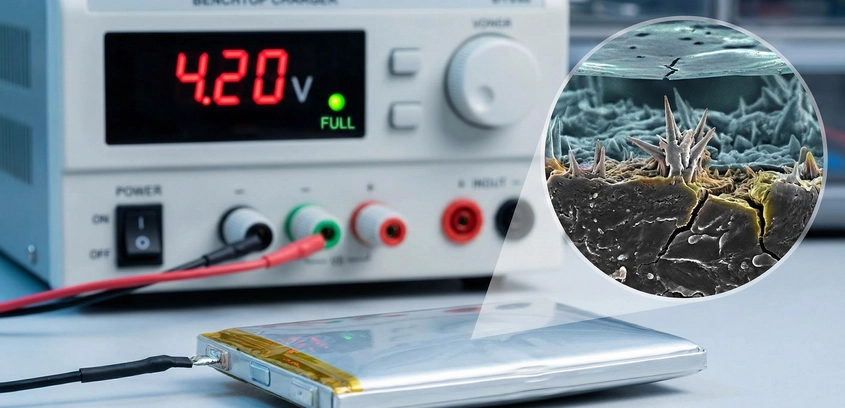
The Lead-Acid Legacy ProblemMost people transitioning to Lithium Iron Phosphate (LiFePO4) or Li-Ion come from a background of dealing with cars, boats, or old-school solar arrays using Lead-Acid (AGM or Gel) batteries. In that world, the rule is simple: Keep it full at all times. Lead-acid batteries suffer from "Sulfation" if left partially discharged. To prevent this, chargers use a "Float" stage—a constant, low-current voltage intended to keep the battery at 100% indefinitely.If you apply this "Float" mentality to a Lithium battery, you are effectively committing chemical murder. Lithium chemistry does not suffer from sulfation. Instead, it suffers from High Voltage Stress. This guide explains the molecular reasons why lithium needs to "relax" and how to configure your equipment to stop the silent degradation.1. The Chemistry of High Voltage StressA lithium battery is at its most stable when the ions are distributed somewhat evenly between the anode and cathode (around 50% State of Charge). When you charge a cell to 100% (4.2V for Li-Ion or 3.65V for LFP), you have forcibly moved almost all the lithium ions to the anode side.This creates a state of high chemical potential energy. While in this state, two parasitic reactions occur:A. Electrolyte OxidationThe liquid electrolyte inside the cell is only stable within a certain "voltage window." At 4.2V, the electrolyte begins to slowly break down (oxidize) at the cathode interface. This decomposition creates microscopic bubbles of gas (leading to pouch swelling) and creates acidic byproducts that eat away at the internal structures. (See our guide on Dealing with Puffed Batteries).B. SEI Layer GrowthThe Solid Electrolyte Interphase (SEI) is a protective film on the anode. While necessary, a "Float" charge causes this layer to grow too thick. As the SEI thickens, it traps lithium ions permanently, reducing the battery's capacity and increasing its internal resistance. The battery becomes "sluggish" and loses its punch.2. The "Saturation" MythLead-acid batteries need hours of "Absorption" and "Float" to finish the chemical conversion of lead sulfate. Lithium does not. Once a lithium battery hits its target voltage and the current tapers off to near zero, it is 100% finished. Adding more time at that voltage provides zero additional capacity but adds significant chemical wear.The Rule: Lithium prefers to be charged, then immediately allowed to drop to its resting voltage.3. Configuring Solar MPPT ControllersStandard solar controllers (Victron, EPEVER, Growatt) usually have a "Float" setting that cannot be disabled entirely. You must "hack" the settings to protect your lithium bank.The Strategy for 12V LiFePO4 (4S)Bulk / Absorption Voltage: 14.2V - 14.4V. (Gets the cells to 95-98% full).Absorption Time: 15 to 30 minutes. (Just enough for the BMS to balance).Float Voltage: 13.4V - 13.5V.Why 13.5V? The resting voltage of a full LiFePO4 cell is roughly 3.35V to 3.37V ($13.4V - 13.5V$ for the pack). By setting the Float to this level, the charger is essentially "standing by." It isn't pushing current into the battery; it is just providing the house loads (lights, fridge) while the battery sits in a stress-free state. If the sun goes down and the voltage drops to 13.3V, the charger does nothing. This allows the battery to "breathe" rather than being choked at 14.6V all day.4. The UPS and Backup Power TrapIf you are using lithium in a UPS (Uninterruptible Power Supply), the battery might sit for years without being used. If the UPS holds the battery at 100% (4.2V/cell) for those two years, the battery will likely fail the very first time you actually need it in a blackout.The Pro Setup: For batteries that are rarely cycled, the "Long Life" voltage is 3.90V to 4.00V per cell (NMC) or 3.35V (LFP). This is roughly 80% capacity. You sacrifice 20% of your runtime for a 400% increase in calendar life. In a medical backup or server room, this trade-off is mandatory for reliability. Refer to Battery Life Cycle metrics for more data on voltage vs. longevity.5. Lithium Plating during "Trickle"There is a dangerous phenomenon where low-current charging at high voltages can cause Lithium Plating even at room temperature. Because the ions are moving so slowly, they don't always find a "parking spot" inside the graphite anode; instead, they deposit on the surface. These deposits eventually grow into dendrites. Unlike lead-acid, where "trickle charging" is safe, "trickle charging" lithium is a recipe for a localized short circuit.6. Summary of Settings per ChemistrySettingLi-Ion (NMC)LiFePO4 (LFP)Max (Do Not Exceed)4.20V / cell3.65V / cellDaily Charge Target4.10V / cell3.50V / cellResting Voltage (Full)4.10V / cell3.37V / cellRecommended Float4.00V / cell3.35V / cellStorage (Long Term)3.80V / cell3.30V / cellThe transition from Lead-Acid to Lithium requires un-learning decades of "best practices." Lithium is a high-performance chemical athlete; it needs to work hard and then rest. By lowering your float voltages and reducing your absorption times, you transform a battery that would last 3 years into one that effortlessly reaches 10 years of service. Silence the "full at all costs" instinct and let your chemistry relax.

28 Oct 2025 Read More
Charger Selection: ISDT vs. Meanwell Industrial Supplies Charging & Safety

Charger Selection: ISDT vs. Meanwell Industrial Supplies

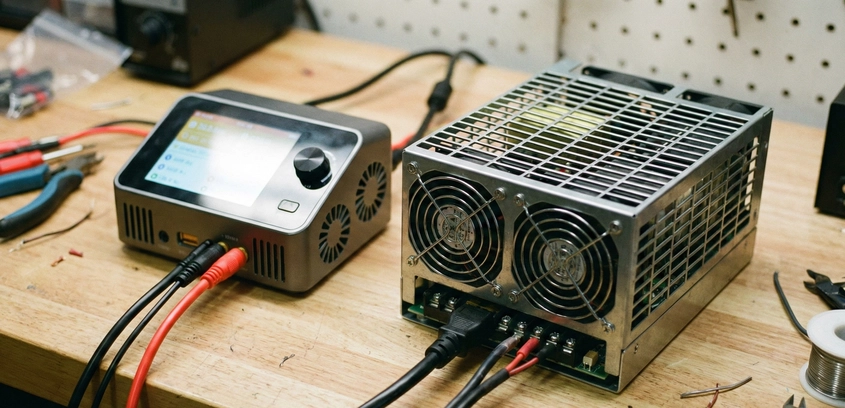
The Final Link in the Power ChainYou have spent weeks sourcing Grade A cells, spot welding with precision, and configuring a smart BMS. Now comes the decision that determines the daily health of your pack: the charger. In the DIY community, charger selection is often a battle between two philosophies. On one side, you have the "Smart Chargers" from the RC and drone world—highly precise, feature-rich, and capable of monitoring individual cells. On the other side, you have "Bulk Chargers" or industrial power supplies like Meanwell—silent, robust, and designed for decades of service.Choosing the wrong charger isn't just about slow speeds; it is about managing the saturation point of the anode. A charger that overshoots voltage by just 0.05V can, over 100 cycles, significantly reduce the life of your pack. In this guide, we will analyze the hardware architecture of these devices and provide a decision matrix for your specific application.1. Smart Chargers (ISDT, iCharger, SkyRC)Smart chargers are essentially specialized computers with an integrated buck-boost converter. They are designed for the high-performance world where every millivolt matters.The Advantage: Individual Cell ManagementThe primary benefit of an RC-style smart charger is the Balance Port. By connecting the BMS balance leads (or a dedicated balance harness) to the charger, the device can see the voltage of every individual series group. If Group 4 is lagging behind, the charger can shunt current away from the high cells, ensuring the entire pack reaches the target voltage simultaneously.Precision and DataDevices like the iCharger 458DUO or ISDT Q8 offer precision down to three decimal places. They allow you to measure the Internal Resistance of each cell during the charge cycle. This is an invaluable diagnostic tool; if you see the IR of one group rising week after week, you know a weld is failing or a cell is dying before it leads to a fire.The Downside: Complexity and Power LimitsSmart chargers are rarely "plug and play." They require a separate DC power supply to feed them, leading to a "messy" workbench with many cables. Furthermore, they are active-cooled with small, high-RPM fans that are noisy and prone to failure in dusty environments. They are fantastic for the lab, but terrible for a permanent e-bike installation.2. Bulk Chargers (Meanwell HLG/ELG Series)In the e-bike and stationary storage world, many pros have moved away from dedicated "battery chargers" in favor of high-end LED drivers or industrial power supplies, specifically the Meanwell HLG series.Why an LED Driver?An LED driver like the HLG is designed to run at 100% load for 10 years in the rain. They are completely fanless (potted in epoxy), silent, and IP67 waterproof. Most importantly, they operate in Constant Current (CC) mode when the load exceeds their rating. This matches the first phase of the CC/CV Charging Profile perfectly.The Reliability FactorA Meanwell supply has a MTBF (Mean Time Between Failure) measured in hundreds of thousands of hours. If you are building a commuter e-bike or a boat battery that needs to charge overnight, every night, for five years, a fanless industrial supply is infinitely more reliable than a plastic RC charger.The Downside: No LogicA Meanwell is a "dumb" device. It will keep pushing voltage until it hits its setpoint. It has no "Termination" logic. While a smart charger will beep and cut power when the current drops to 100mA, a Meanwell will sit at the target voltage forever. This is why a bulk charger MUST be used in conjunction with a high-quality BMS that can handle the final cutoff if necessary.3. The Physics of Voltage Drop in ChargingA charger measures the voltage at its terminals, not the battery's terminals. If you use long, thin charging cables, the resistance of the wire creates a voltage drop ($V=I imes R$).The Scenario: Your charger is set to 54.6V. You are pushing 10A through 22 AWG wire. The wire drops 0.5V. The charger "thinks" the battery is at 54.6V and enters the CV (Constant Voltage) phase early. In reality, the battery is only at 54.1V. Result: Charging becomes painfully slow, and the battery never truly reaches 100% saturation. Solution: Always use at least 14 AWG or 12 AWG wire for your charging path, even if the current is low, to ensure the charger sees the true state of the cells.4. AC/DC Efficiency and HeatEvery watt lost in conversion is a watt of heat. - Cheap "Aluminium Brick" chargers often have efficiencies around 75-80%. - Meanwell HLG units hit 94-95% efficiency. In a closed garage, the difference between an 80% and a 95% efficient charger is the difference between a warm device and a fire hazard. Heat is the enemy of electrolytic capacitors inside chargers; for every 10°C rise, their lifespan is halved.5. Decision Matrix: Which One for You?ApplicationRecommended TypeWhy?New Pack BuildingSmart Charger (ISDT/iCharger)Need cell-level balancing and IR testing for initial setup.Commuter E-BikeBulk Charger (Meanwell HLG)Needs to be silent, waterproof, and survive vibration in a backpack.Solar StorageMPPT ControllerRequires specialized logic to handle varying solar input currents.Recycled Cell GradingMulti-Channel (Opus/MegaCell)Need automation for high-volume capacity testing.6. Safety Protocols for High-Current ChargingWhen charging at rates over 10 Amps, your connectors (XT60 or DC Barrel) are under stress. 1. Avoid DC Barrels: Standard 5.5x2.1mm barrel jacks are rated for 5A max. Pushing 8A through them will melt the plastic and cause a short. Use XT60 or XLR connectors for charging. 2. Thermal Monitoring: Tape a BMS temperature probe to the main charging wires. If a connector becomes loose and generates heat, the BMS can shut down the cycle before the plastic ignites.Ultimately, a charger is a life-support system. A high-quality power supply is a one-time investment that protects thousands of dollars in battery cells. Don't trust a $1000 battery to a $20 "no-name" charger from eBay.

25 Oct 2025 Read More
Pre-charge Resistors: Why and How to Use Them Charging & Safety

Pre-charge Resistors: Why and How to Use Them

The Arc Flash at Your FingertipsYou have just finished your high-power 48V or 72V battery build. You reach for the XT90 or Anderson connector to link it to your inverter or motor controller. As the pins touch, a bright blue flash erupts, accompanied by a sharp "CLACK" sound. You look at your gold-plated connector and see a black, pitted crater where the metal was vaporized.This is the Inrush Current Spike. While many hobbyists ignore it, this spark is the leading cause of premature failure in connectors, BMS MOSFETs, and inverter input capacitors. In this guide, we will analyze the electrical physics of why this happens and show you how to eliminate it forever using a simple $1 component: the Pre-charge Resistor.1. The Physics: The Capacitor ProblemThe input stage of every motor controller (VESC, Kelly, Sabvoton) and every solar inverter (Victron, Growatt) is dominated by a bank of large Electrolytic Capacitors. These capacitors act as a buffer to stabilize the DC voltage during heavy load spikes.When the system is off, these capacitors are empty (0 Volts). A capacitor, for the first millisecond of charging, behaves exactly like a Short Circuit. It has near-zero resistance. When you connect a 50V battery to an empty capacitor bank: Formula: $I = V / R$. If the wire and capacitor resistance is only 0.05 Ohms, the instantaneous current is: $50V / 0.05Omega = mathbf{1000 Amps}$.That 1000A surge lasts only for a few microseconds, but it is enough energy to turn air into plasma (the spark). This surge pits the gold plating, allowing corrosion to set in, and can even "punch through" the delicate gates of the MOSFETs inside your BMS, causing it to fail in the "Always Off" position.2. How a Pre-charge Resistor WorksThe goal is to fill those capacitors slowly rather than all at once. By placing a high-wattage resistor in the path of the current for 2 to 5 seconds, we limit the flow of electrons. Instead of 1000 Amps, we limit the flow to perhaps 1 or 2 Amps. This "pre-charges" the capacitors until their voltage matches the battery voltage. Once the voltage is equalized, there is no pressure differential, and the main connection can be made with zero sparks.3. Calculating the Resistor ValueYou don't need a specific "pre-charge brand" resistor. Any power resistor will work. You need to balance two factors: Resistance (Ohms) and Power (Watts).The Ohm CalculationYou want to limit the current to around 1-2 Amps to avoid tripping the BMS but charge fast enough so you don't have to wait 20 seconds. Formula: $R = V_{battery} / I_{target}$. For a 48V system (54V max): $54V / 1A = 54Omega$. A 40-ohm to 100-ohm resistor is standard for most e-bike and solar builds.The Wattage CalculationThe resistor only works for a few seconds, so it doesn't need to be massive. However, it handles the full voltage of the battery. A small 1/4 watt resistor will explode. You need a 5 Watt or 10 Watt ceramic "cement" resistor or an aluminum-housed power resistor. They are designed to take brief pulses of high energy.4. Implementation MethodsMethod A: The "Touch and Plug" (Manual)The simplest way for e-bikers. 1. Solder a 100-ohm resistor across a separate small set of wires or even onto the tip of one probe. 2. Touch the negative leads together. 3. Touch the positive lead to the terminal through the resistor for 3 seconds. 4. Quickly plug in the main connector. Pros: Zero cost. Cons: Annoying to do every time.Method B: The Antispark Connector (XT90-S)This is the most elegant solution for DIYers. The Amass XT90-S connector (The green one) has a built-in pre-charge resistor in the tip of the male plug. When you push the plug in, the first 2mm of travel connects through the resistor. By the time you push it all the way home, the capacitors are full, and the main high-current contacts meet silently. (Learn more in our Connector Selection Guide).Method C: The Push-Button (Hardwired)For Powerwalls and large Inverters. 1. Install a large DC circuit breaker for the main positive line. 2. Wire a resistor in parallel with the breaker, with a momentary push-button switch in series with the resistor. Operating Sequence: 1. Hold the "Pre-charge" button for 5 seconds. 2. Flip the main breaker to "ON." 3. Release the button.5. When is Pre-charge Mandatory?Voltages > 36V: At 12V and 24V, the spark is small and manageable. At 48V, 52V, and 72V, the spark is destructive.Large Inverters: Any inverter over 2000W has massive capacitor banks that will trip a BMS short-circuit protection if not pre-charged.High-End Connectors: If you are using expensive $20-per-pair connectors, don't ruin them with pitting.SummaryThe "Spark" is the sound of your hardware dying. Implementing a pre-charge solution—whether through an XT90-S connector or a manual resistor circuit—is the hallmark of a professional battery build. It protects your BMS, extends the life of your capacitors, and prevents the carbon buildup that leads to high-resistance connections. Silence is golden in high-voltage electronics.

24 Oct 2025 Read More