Latest Articles

Page 9 of 10
Introduction to LTO (Lithium Titanate) Batteries Cell Types & Chemistry

Introduction to LTO (Lithium Titanate) Batteries

The Battery That Outlives the ApplicationIn the world of lithium batteries, there is always a trade-off. If you want high energy density, you sacrifice safety (NMC). If you want safety and long life, you accept heavy weight (LFP). But sitting in a corner, largely ignored by the mainstream, is a chemistry that breaks almost all the rules of degradation: Lithium Titanate Oxide (LTO).LTO is not just an incremental improvement; it is a fundamental redesign of the anode. While standard lithium-ion cells use Graphite to hold lithium ions, LTO uses nanocrystals of Lithium Titanate. This change grants the battery superpowers: 20,000 to 30,000 cycles, extreme safety, and massive power delivery. It is the closest thing we have to a "forever battery."1. The "Zero Strain" PropertyWhy do batteries die? In Graphite anodes (used in NMC and LFP), the intercalation (insertion) of lithium ions causes the graphite lattice to expand by about 10%. Over thousands of cycles, this constant breathing causes the material to crack and degrade. The Internal Resistance rises, and the cell fails.LTO crystals, however, have a "Zero Strain" property. When lithium ions enter the titanate structure, the volume change is negligible (less than 0.2%). There is no mechanical stress. Because the structure doesn't physically break down, the cycle life is astronomical.NMC: ~800 Cycles.LiFePO4: ~4,000 Cycles.LTO: ~25,000+ Cycles.If you cycle an LTO battery once a day, it would theoretically last 68 years. The battery will likely outlive you.2. Extreme Temperature PerformanceWe typically warn builders never to charge lithium below freezing. Doing so causes lithium plating, which destroys the cell. (See our Temperature Guide).LTO is the exception. The electrochemical potential of the Titanate anode is higher (1.5V vs Li) than Graphite (0.1V vs Li). This means lithium plating is thermodynamically impossible under normal conditions, even at extreme discharge rates or low temperatures.Operating Range: You can safely charge and discharge LTO cells at -30°C (-22°F). For Arctic expeditions, aerospace applications, or unheated cabins in Canada, LTO is often the only chemistry that works without complex heating systems.3. The Power of C-RatingsBecause the nanocrystals have a massive surface area (100 m²/g vs 3 m²/g for graphite), ions can move in and out with incredible speed.Charge Rate: 6C to 10C. (0% to 100% in 6-10 minutes).Discharge Rate: 10C to 30C continuous.This behavior makes LTO act almost like a Supercapacitor. It is widely used in electric buses that charge for 5 minutes at every bus stop, and in high-end Car Audio competitions where thousands of amps are needed instantly to prevent voltage drop on bass hits.4. The Downsides (Why it isn't everywhere)If LTO is so perfect, why doesn't Tesla use it?A. Energy Density (The Weight Problem)LTO has a very low cell voltage (2.3V or 2.4V nominal) and the materials are heavy. Gravimetric Density: ~80 Wh/kg. This is half the density of LFP and one-third of NMC. An LTO battery pack for a Tesla Model S would weigh 3,000 lbs. It is simply too heavy for long-range EVs or portable electronics.B. Low Voltage = More CellsBuilding a 12V or 48V battery requires more cells in series.12V Nominal: LFP needs 4 cells (4S). LTO needs 5 or 6 cells (5S is 12.0V, 6S is 14.4V).48V Nominal: LFP needs 16 cells (16S). LTO needs 20 to 22 cells (22S).More cells mean more connections, more complexity, and larger BMS wiring harnesses.C. CostTitanium is more expensive than Carbon. Manufacturing volumes are lower. LTO currently costs roughly $400-$600 per kWh, compared to $100-$150 for LFP. The upfront cost is massive, even if the "Total Cost of Ownership" over 30 years is lower.5. BMS ChallengesYou cannot use a standard Li-Ion or LiFePO4 BMS for LTO. The voltage range is completely different.Max Voltage: 2.8V - 2.9VNominal Voltage: 2.3V - 2.4VMin Voltage: 1.5V (can go to 0V safely, but BMSs cut higher).If you connect a standard BMS, it will think the cell is "dead" (Under Voltage Protection) at 2.4V. You must buy a specialized LTO Smart BMS or a fully programmable unit where you can manually set the thresholds.6. Form Factors: The Yinlong CylindersThe most common LTO cells available to DIYers are the cylindrical Yinlong 66160 cells (66mm diameter, 160mm length). Specs: 40Ah capacity. These huge blue cylinders feature threaded studs, making them easy to assemble with busbars. However, due to the high current capability (10C = 400 Amps!), you must use massive copper busbars and ensure torque specs are perfect to avoid melting the terminals.Conclusion: Who is LTO for?LTO is a niche, high-performance chemistry. It is not for the average solar homeowner (buy LFP for that). Build with LTO if: 1. You live in extreme cold and need charging without heating. 2. You need a battery that will last 30 years without maintenance (remote telecom towers). 3. You need extreme power density (Car Audio, Drag Racing). 4. You want the absolute safest lithium chemistry known to man (highly resistant to thermal runaway even when punctured).

07 Sep 2025 Read More
Sodium-Ion Batteries: A DIY Perspective Cell Types & Chemistry

Sodium-Ion Batteries: A DIY Perspective

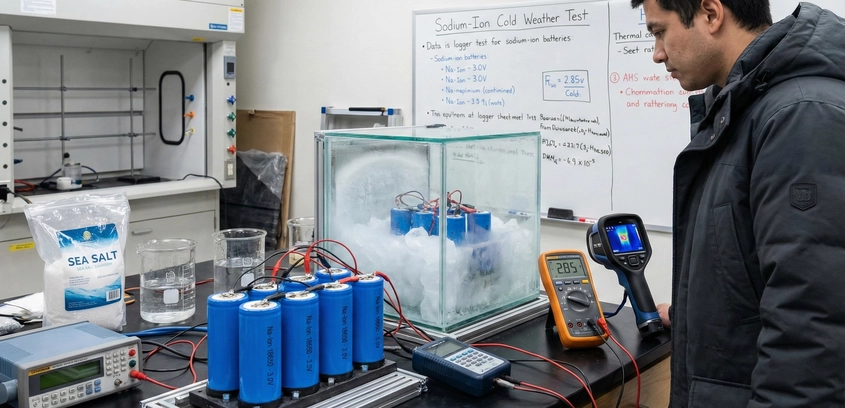
The Salt RevolutionFor thirty years, the battery world has been defined by the "Rocking Chair" principle of Lithium ions moving between cathode and anode. But Lithium has problems: it is rare (0.002% of Earth's crust), expensive to mine, and geographically concentrated in politically complex regions.Enter Sodium (Na). It makes up 2.6% of the Earth's crust. It is the sixth most common element. It costs pennies compared to Lithium. And recently, companies like CATL and HiNa have cracked the code to make Sodium-Ion batteries commercially viable. But do they live up to the hype for the DIY builder?1. The Chemistry: Bigger Ions, Harder ProblemsSodium and Lithium are neighbors on the Periodic Table (Alkali Metals). They behave similarly chemically. However, a Sodium ion is physically larger (0.102 nm radius) than a Lithium ion (0.076 nm).This size difference was the historical showstopper. Sodium ions were too fat to fit into the standard Graphite anode used in Li-Ion cells. They would crack the graphite structure after a few cycles. The Breakthrough: Hard Carbon. Researchers developed "Hard Carbon" (disordered carbon) anodes with larger pores, allowing Sodium ions to intercalate smoothly. This unlocked cycle life comparable to early Lithium cells.2. The Killer Feature: Cold Weather PerformanceIf you have ever tried to charge an LFP battery at -5°C, you know it refuses. Lithium plating destroys the cell. Sodium-Ion is a winter beast. Retention: It retains over 90% capacity at -20°C. Charging: Unlike LFP, many Na-Ion chemistries can accept a charge at sub-zero temperatures without instant plating damage. For off-grid cabins in Canada or Scandinavia, this single feature makes Sodium superior to LFP, eliminating the need for complex heating pads.3. The Safety Feature: 0 Volt DischargeLithium batteries are dangerous to ship because they must contain energy. Discharging a Li-Ion cell to 0V kills it chemically (copper dissolution).Sodium-Ion cells use aluminum current collectors for both the cathode and anode. (Li-Ion needs copper for the anode because Lithium reacts with aluminum at low voltages; Sodium does not). The Result: You can discharge a Sodium-Ion battery to 0.0 Volts. You can short-circuit the terminals (when empty). You can ship it completely dead. It is chemically stable. When you receive it, you charge it up, and it works perfectly. This completely removes the fire risk during transport and storage.4. The Drawback: Energy DensityPhysics is cruel. Sodium is heavier than Lithium and has a lower standard electrode potential (-2.71V vs -3.04V). Current Density: ~140-160 Wh/kg. This puts First-Gen Sodium roughly on par with LiFePO4 (LFP), but significantly behind NMC (250 Wh/kg). You will likely never see a Sodium-Ion long-range electric car or smartphone. It is simply too heavy and bulky. However, for stationary storage (Powerwalls) or low-range city cars, density is less critical.5. The Voltage Curve WeirdnessSwitching to Sodium requires new equipment settings. Nominal Voltage: ~3.0V or 3.1V. Voltage Range: 1.5V to 4.0V. This is a massive, sloping discharge curve. It does not have the flat curve of LFP. This makes State of Charge (SOC) estimation very easy (voltage = percentage), but it means your inverter needs a very wide input voltage range to utilize the full capacity.Compatibility Check: A standard 48V inverter usually cuts off at 40V-42V. A 16S Sodium pack might need to go down to 30V to be fully empty. Using standard Li-Ion equipment might leave 30% of the Sodium capacity unused.6. Cost: The Promise vs. RealityTheoretically, Sodium cells should be 30-40% cheaper than LFP because they don't use Lithium or Copper. Reality Today: Because production scale is low, Sodium cells are currently more expensive or the same price as mass-produced LFP. The economic advantage will only arrive once Gigafactories switch over fully. We are in the "Early Adopter Tax" phase.Verdict: Is it Ready for DIY?Yes, but with caveats. You can buy cylindrical (32140) and Prismatic Sodium cells today. They are excellent for: 1. Extreme Cold Climates: Where LFP fails. 2. Safety-Critical Storage: Where 0V storage is a benefit.For the average user in a temperate climate, standard LiFePO4 is still the better buy today due to maturity, higher cycle life (6000 vs 3000 for Sodium), and vast compatibility with existing 48V inverters. But watch this space—Sodium is the inevitable future of grid storage.

05 Sep 2025 Read More
Prismatic, Cylindrical, and Pouch Cells Compared Cell Types & Chemistry

Prismatic, Cylindrical, and Pouch Cells Compared

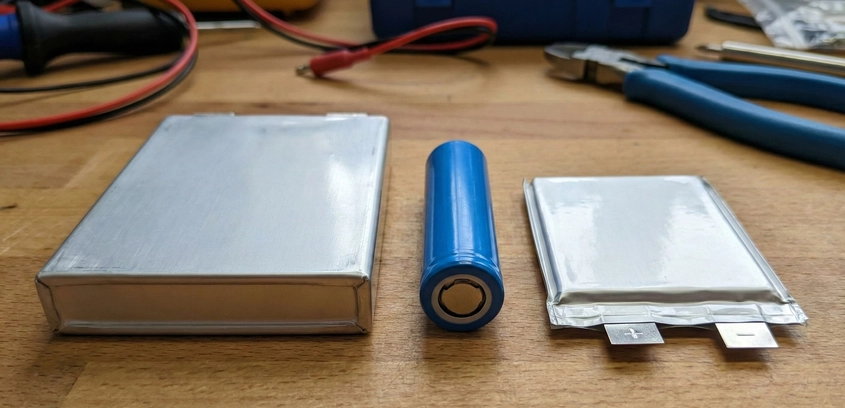
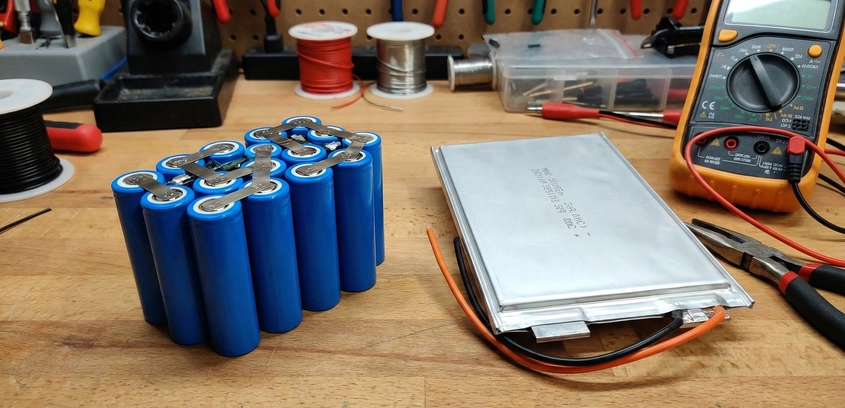
It is Not Just Chemistry; It is GeometryWhen designing a battery pack, most enthusiasts focus obsessively on the chemistry (NMC vs. LFP). While vital, the physical form factor of the cell—the "can" or "bag" that holds that chemistry—dictates nearly every aspect of the assembly process, thermal management strategy, and mechanical durability of your final product.The three dominant form factors in the industry are Cylindrical (18650, 21700), Prismatic (Large bricks), and Pouch (Soft packs). Each was evolved to solve a specific engineering problem, and each introduces its own set of headaches for the DIY builder. Choosing the wrong form factor can lead to a pack that is impossible to cool, impossible to assemble without $5,000 tools, or structurally unsafe.1. Cylindrical Cells: The Tesla StandardThe cylindrical cell is the most mature technology in the lithium world. It is essentially a "jelly roll"—the cathode, separator, and anode are wound into a tight spiral and stuffed into a nickel-plated steel can.The Pros: Mechanical InvincibilityThe cylinder is one of nature's strongest shapes. It resists internal pressure (swelling) exceptionally well. Because the steel can acts as a pressure vessel, cylindrical cells rarely require external compression frames.Safety Vents (CID): Most 18650/21700 cells have a built-in Current Interrupt Device (CID) and a burst disc. If internal pressure builds up, the top cap pops, physically disconnecting the circuit before an explosion occurs. This is a massive safety layer not found in pouches.Thermal Management: When you stack cylinders, you inevitably create diamond-shaped air gaps between them. While this hurts volumetric density, it is a blessing for cooling. You can force air or liquid coolant through these gaps to manage core temperatures effectively.Standardization: Whether you buy a Samsung, LG, or Molicel, an "18650" is always 18mm x 65mm. This makes designing 3D Printed Holders extremely predictable.The Cons: Assembly HellBuilding a large pack requires connecting hundreds of individual cells. A 10kWh Powerwall using 18650s might require 1,000 cells. That means 2,000 spot welds, 1,000 insulators, and a complex web of nickel strips. If one spot weld fails, that cell drops out of the group. If one cell shorts, it can affect the whole bank.2. Prismatic Cells: The DIY Powerwall FavoriteIf you see a large blue brick (like EVE or CATL cells), that is a Prismatic cell. These are essentially the same "jelly roll" as a cylinder, but flattened out and shoved into a rectangular aluminum or steel box.The Pros: Capacity and AssemblyThe single biggest advantage of Prismatic cells is Capacity per Connection. A single 280Ah Prismatic cell holds the same energy as roughly eighty 3500mAh 18650s. To build a 48V battery, you only need to connect 16 of these bricks in series. That is 15 busbar connections total, compared to thousands of welds for a cylindrical pack.Screw Terminals: Most Prismatics come with laser-welded studs (M6 or M4). You can assemble a massive pack with a simple torque wrench—no Spot Welder required.Volumetric Density: They stack like books with zero air gaps. This offers the highest theoretical energy density for a given box size.The Cons: The Swelling ProblemFlat sides are structurally weak against internal pressure. As the anode expands during charging, the flat faces of a Prismatic cell will bulge outward. The Trap: If you do not restrain them, this swelling causes the internal layers to delaminate (separate), increasing internal resistance and killing the cell. You MUST build a compression fixture to apply constant pressure (usually 10-15 PSI) to keep the cell flat over its lifespan.3. Pouch Cells: The High-Performance Glass CannonPouch cells (Lithium Polymer / LiPo) are the rawest form of battery. It is the electrode stack sealed inside an aluminum-polymer foil bag. There is no hard metal case.The Pros: Power-to-Weight RatioWithout the heavy steel case, pouch cells have the highest Gravimetric Energy Density (Wh/kg). This is why every drone, smartphone, and laptop uses them. Furthermore, the tabs (positive and negative) usually span the entire width of the cell, offering massive surface area for current flow. This allows for insane C-Ratings (50C-100C) that cylinders and prismatics can only dream of.The Cons: Extreme FragilityPouch cells are delicate. A fingernail can puncture the pouch, leading to a fire. If they generate gas (puffing), there is no hard case to contain it. Assembly Difficulty: The tabs are usually thin aluminum (positive) and nickel/copper (negative). You cannot solder to aluminum easily. You need specialized ultrasonic welding gear or tricky mechanical clamping methods. For the average DIYer, raw pouch cells are a nightmare to assemble reliably.4. Comparison Matrix: Which to Choose?FeatureCylindricalPrismaticPouchAssemblyHard (Welding)Easy (Bolting)Very Hard (Clamping/Ultrasonic)SafetyHigh (CID/PTC)Medium (Vents)Low (Easy Puncture)CoolingExcellent (Air Gaps)Poor (Core heat)Good (Large Surface)Density (Wh/L)MediumHighHighBest UseE-Bikes, ToolsSolar Storage, RVsDrones, Wearables5. The Verdict for Your BuildScenario A: The E-Bike / Skateboard You have an irregular space (a downtube or a flat deck) and need high vibration resistance. Choose: Cylindrical (21700). The steel cans protect against road debris impacts, and you can glue them into custom shapes to fit the enclosure.Scenario B: The Home Solar Bank You need 10kWh of storage sitting on a shelf in the garage. Weight doesn't matter. Choose: Prismatic (LFP). The ease of bolting together 16 large cells with busbars outweighs every other factor. It is the cheapest and fastest way to build bulk storage.Scenario C: The Racing Drone Every gram counts. You need 100 Amps instantly. Choose: Pouch (LiPo). Accept the short cycle life and fire risk for the sheer performance and light weight.SummaryDon't fight the form factor. Trying to build an e-bike battery out of giant Prismatic bricks usually results in a bulky, unmountable mess. Trying to build a Powerwall out of 2,000 used 18650s is a rite of passage, but ultimately a maintenance nightmare compared to 16 Prismatics. Match the geometry to the job.

04 Sep 2025 Read More
LiFePO4 vs. NMC Chemistry Comparison Cell Types & Chemistry

LiFePO4 vs. NMC Chemistry Comparison

The Two Philosophies of Energy StorageIn the lithium battery world, there are two dominant tribes. On one side, you have the NMC / NCA (Nickel Manganese Cobalt / Aluminum) camp. These are the chemistry of Tesla, high-end smartphones, and performance drones. They prioritize Energy Density and speed above all else. On the other side, you have the LiFePO4 (Lithium Iron Phosphate, or LFP) camp. These are the workhorses of solar storage, RVs, and buses. They prioritize Safety and Longevity.Choosing the wrong chemistry for your application is not just inefficient; it can be dangerous. Let's strip away the marketing and look at the molecular differences.1. The Molecular Bond: Oxygen ManagementThe primary difference lies in the cathode material. NMC (LiNiMnCoO2): The oxygen in the cathode is held by a relatively weak metal-oxide bond. When the cell heats up (due to overcharging or physical damage), this bond breaks easily, releasing oxygen. LFP (LiFePO4): The oxygen is held in a Phosphate ($PO_4$) bond. In chemistry, the phosphorus-oxygen bond is incredibly strong (covalent). It is extremely difficult to break this bond, even at high temperatures.Why This Matters for SafetyFire needs three things: Heat, Fuel, and Oxygen. Inside a battery, the electrolyte is the Fuel. The short circuit provides the Heat. In an NMC fire, the cathode decomposes and provides its own Oxygen. This means you cannot smother an NMC fire. It will burn underwater. It will burn in a vacuum. It burns until the fuel is gone. In an LFP cell, the oxygen stays locked in the phosphate molecule. If an LFP cell shorts, it gets hot, vents smoke, and maybe creates a small flame from the electrolyte, but it rarely enters the violent, self-sustaining "Thermal Runaway" loop that NMC does. (See Thermal Runaway Points).2. Cycle Life: The 10-Year BatteryWhen you charge a battery, lithium ions physically move into the anode. This causes the materials to expand and contract. NMC: The crystal structure degrades over time. Typical rating: 500 to 1000 Cycles (to 80% capacity). LFP: The olivine crystal structure is extremely stable. Typical rating: 3000 to 6000+ Cycles.Real World Math: If you cycle your battery once a day: NMC lasts ~2-3 years before noticeable degradation. LFP lasts ~10-15 years. For a solar home installation where you want to install it and forget it for a decade, LFP is the only logical choice.3. Energy Density: The Weight PenaltyIf LFP is so safe and lasts forever, why doesn't Tesla use it in the Model S Plaid? Answer: Weight. LFP has a lower nominal voltage (3.2V) compared to NMC (3.6V/3.7V). It also holds fewer lithium ions per gram of material.NMC Density: ~250 Wh/kg.LFP Density: ~150 Wh/kg.An LFP battery will be nearly twice as heavy and 30% larger than an NMC battery of the same capacity. For a house (Powerwall), weight doesn't matter. The concrete slab doesn't care if the battery weighs 200lbs or 400lbs. For a drone or a performance car, that extra weight kills performance and range.4. The Voltage Curve ChallengeNMC has a steep, linear discharge curve. 4.2V = 100% 3.6V = 50% 3.0V = 0% It is very easy for a BMS to read the voltage and tell you exactly how much percentage is left.LFP has a famously Flat Curve. 3.40V = 99% 3.29V = 70% 3.28V = 40% 3.00V = 1% Between 80% and 20% charge, the voltage barely changes. It sits around 3.2V - 3.3V the entire time. This makes it incredibly difficult for cheap BMS units to estimate "State of Charge" (SOC). You need a high-quality Coulomb Counting BMS (Smart Shunt) that measures amps in/out rather than relying on voltage, or you will never know if your battery is half full or nearly empty.5. Cold Weather PerformanceBoth chemistries suffer in the cold, but LFP is more sensitive. While NMC can often be charged at reduced rates down to 0°C or -5°C (with care), LFP is strictly Forbidden to Charge below 0°C. Doing so causes immediate, permanent plating damage. If you use LFP in an unheated garage or RV, you must have heating pads and a BMS with a Low-Temp Cutoff sensor.6. CostCobalt and Nickel are expensive, rare, and subject to volatile supply chains (and ethical mining concerns). Iron and Phosphorus are dirt cheap and abundant. LFP cells are significantly cheaper per kWh than NMC cells. This economic advantage, combined with the cycle life, makes the "Levelized Cost of Storage" (Total Cost / Total Useful Cycles) of LFP unbeatable for stationary storage.Summary: Which One to Build?Choose NMC (18650/21700) if: - You are building an E-Bike, Electric Skateboard, Drone, or portable tool. - Weight and size are critical constraints. - You need extreme discharge currents (C-Rating > 5C).Choose LFP (Prismatic) if: - You are building a Solar Powerwall, RV House Bank, or Marine Bank. - You want the battery to last 10+ years. - You are storing the battery inside your home and want maximum fire safety. - You are on a budget and weight is irrelevant.Ultimately, the "best" chemistry is the one that matches the specific needs of your physics problem. Don't force a heavy LFP brick onto a racing drone, and don't put a volatile NMC bomb in your basement solar closet.

03 Sep 2025 Read More
18650 vs. 21700: Choosing the Right Cell Cell Types & Chemistry

18650 vs. 21700: Choosing the Right Cell

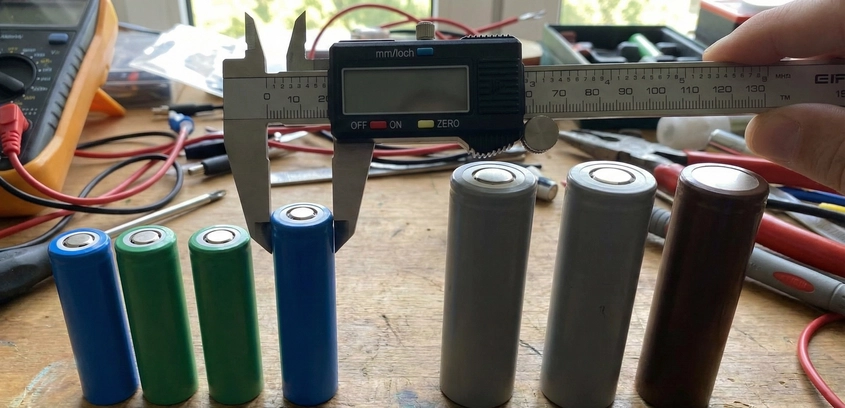
The Evolution of the Jelly RollFor nearly two decades, the 18650 cell (18mm diameter, 65mm length) was the undisputed king of portable power. It powered everything from the first Tesla Roadster to your laptop, cordless drill, and vape. It was the standard. Supply chains were optimized for it, and costs were driven down to pennies.Then, around 2017, the paradigm shifted. Tesla and Panasonic introduced the 21700 (21mm diameter, 70mm length) for the Model 3. At a glance, 3 millimeters of extra width and 5 millimeters of height seems negligible. However, in the world of volumetric geometry, this small increase revolutionized energy density.Today, DIY battery builders face a dilemma: Stick with the proven, plentiful 18650, or migrate to the modern, high-capacity 21700? To make this decision, we need to look beyond the datasheet and understand the physics of packing efficiency and thermal management.1. The Geometry of Power: Why 3mm MattersThe magic of the 21700 lies in the square-cube law. The volume of a cylinder is $V = pi r^2 h$. By increasing the diameter from 18mm to 21mm, we aren't just adding linear space; we are squaring the radius. 18650 Volume: $approx 16.5 cm^3$21700 Volume: $approx 24.2 cm^3$This is a volume increase of approximately 47%. However, the energy capacity gains have been even higher due to optimizations in the "dead space" inside the can (less steel casing relative to active material). While a top-tier 18650 tops out at roughly 3500mAh (e.g., Sanyo NCR18650GA), a modern 21700 can easily hit 5000mAh (e.g., Samsung 50S) or even 5800mAh in the latest generations.2. Gravimetric vs. Volumetric DensityIf you are building a drone or a backpack battery, weight (Gravimetric Density) is key. If you are building an e-bike inside a frame tube, size (Volumetric Density) is key. (See our guide on Energy Density Types for more).The Packing Problem: When you pack cylinders together, there is air between them. A pack of 21700s has larger individual air gaps than a pack of 18650s, but because you need fewer cells to achieve the same capacity, the total volume of the finished battery pack is usually smaller with 21700s.Example: Building a 1kWh Pack (36V 28Ah)Using 18650 (3.5Ah): You need 80 cells. That is 160 spot welds, 80 insulators, and a lot of nickel strip.Using 21700 (5.0Ah): You need 56 cells. That is only 112 spot welds.Verdict: The 21700 pack will be lighter and smaller because you are carrying less steel casing and less nickel interconnect material. The energy density at the pack level is superior.3. Power Density and Current HandlingHistorically, 18650s held the crown for raw power. Cells like the Sony VTC5A or Samsung 25R could dump 25A-30A continuously. Early 21700s were focused on capacity (energy) rather than power.However, the new generation of "High Power" 21700s has changed the game. The Samsung 40T and Molicel P42A/P45B are engineering marvels. The Molicel P45B can deliver 45 Amps continuous discharge with a capacity of 4500mAh. To match that current with 18650s, you would need two or three Samsung 25Rs in parallel.This means for high-performance applications (like electric skateboards or racing drones), a 1P or 2P configuration of 21700s can often replace a bulky 3P or 4P configuration of 18650s.4. Thermal Management: The Hidden DownsideThere is no free lunch in physics. The larger diameter of the 21700 means the center of the "jelly roll" (the wound electrode layers) is further away from the cooling surface (the steel can). Heat generated in the core of a 21700 takes longer to migrate to the surface than in a thinner 18650. If you push a 21700 to its absolute thermal limit, the core temperature might be significantly higher than the surface temperature compared to an 18650. This thermal gradient can lead to accelerated aging in the center of the cell. Mitigation: When designing high-amp packs with 21700s, you must leave adequate air gaps between cells or use thermal potting compounds. Do not glue them tightly together if you plan to run them at 30A+ continuous.5. Cost Economics: The Dollar per Watt-HourFor years, 18650s were cheaper because of the massive surplus from old laptop manufacturing lines and modem harvesting. You can still find used 18650s for $1-$2.However, for new cells, the 21700 is now the value leader. A Samsung 35E (18650, 3.5Ah) might cost $5. A Samsung 50E (21700, 5.0Ah) might cost $6. Math: 18650: $5 / 3.5Ah = $1.42 per Ah. 21700: $6 / 5.0Ah = $1.20 per Ah. You get more energy for your money with the larger format because manufacturers spend less time winding and welding cans for the same total energy output.6. Availability and the "Tesla Effect"Tesla has moved on to the 4680 form factor (46mm x 80mm). This massive cell is tabless and currently difficult for DIYers to source or weld (it requires laser welding or specialized gear). Because the automotive industry is moving toward these larger formats (4680, Prismatic), the 18650 supply chain is slowly shrinking. It won't disappear—it is too embedded in power tools—but innovation in 18650 chemistry has plateaued. All the newest R&D (silicon anodes, higher voltages) is happening on the 21700 and 4680 lines.7. When to Stick with 18650?Despite the dominance of the 21700, the 18650 still wins in two scenarios:Space Constraints: If your e-bike downtube is just too thin for a 21mm cell, or your flashlight body is machined for 18mm, you have no choice.Low Current / Low Cost: If you are building a massive solar powerwall where weight and size don't matter, harvesting thousands of free/cheap used 18650s is still the most economical route.Final VerdictIf you are buying new cells today for a traction application (Vehicle, Bike, Board), choose 21700. The energy density, simplified assembly (fewer welds), and cost per kWh are superior. The Molicel P42A/P45B and Samsung 50S are the current gold standards for a reason. The 18650 had a good run, but the torch has been passed.

31 Aug 2025 Read More
Temperature Effects on Lithium Batteries Battery Basics

Temperature Effects on Lithium Batteries

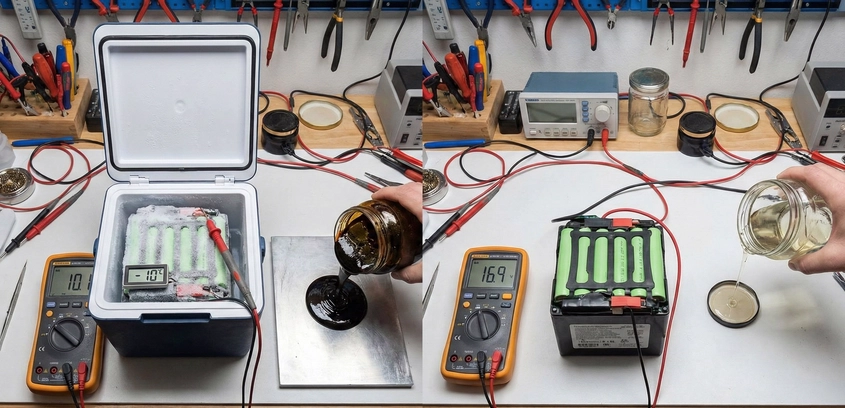
The Thermometer Dictates PerformanceYou can buy the most expensive cells in the world, but if you ignore thermal management, they will be trash in six months. Temperature is the single most significant environmental factor affecting the performance, safety, and longevity of a lithium-ion battery.The "Goldilocks Zone" for Lithium is roughly 20°C to 25°C (68°F - 77°F). Deviating from this causes specific, predictable chemical issues.1. The Cold: Viscosity and PlatingWhen a battery gets cold, the liquid electrolyte inside becomes viscous, like syrup turning into molasses. This slows down the movement of Lithium ions.Discharging in the Cold (Safe but Weak)If you try to run your e-bike at -10°C, you will notice massive Voltage Sag. The ions can't get to the cathode fast enough to satisfy the motor's demand. The internal resistance spikes. Result: Reduced range and power. Damage: Usually temporary. Once the battery warms up, the capacity returns (mostly).Charging in the Cold (The Death Zone)Never charge a lithium battery below freezing (0°C). During charging, ions must intercalate (insert themselves) into the graphite anode layers. When cold, the graphite contraction and electrolyte viscosity make this entry difficult. Instead of entering the anode, the lithium ions pile up on the surface, forming metallic lithium.This is Lithium Plating. 1. It permanently removes lithium from the cycle (Capacity Loss). 2. The metallic dendrites are sharp and grow towards the cathode. If they pierce the separator: Short Circuit -> Fire. This is why high-end BMS units have Low Temp Cutoff sensors. If yours doesn't, you are playing with fire.2. The Heat: Accelerated AgingWhile cold causes acute failure (plating), heat causes chronic disease. Heat accelerates chemical reactions—including the unwanted ones.The Arrhenius EffectA rule of thumb in chemistry is that reaction rates double for every 10°C rise in temperature. Inside a battery, the electrolyte is constantly slowly reacting with the electrodes to form the Solid Electrolyte Interphase (SEI). Heat speeds this up.Operating at 30°C: Normal degradation.Operating at 45°C: Cycle life reduced by ~50%.Operating at 60°C: Rapid electrolyte decomposition, gas generation (puffing), and separator softening.If you leave your laptop in a hot car, or run your Powerwall in an unventilated garage in Arizona, you are aging it in "dog years."3. Thermal Runaway: The Point of No ReturnIf external heat or internal shorts raise the cell temperature beyond a critical threshold, the cathode material begins to break down. Crucial Detail: When cathodes break down, they release Oxygen.LCO (Old tech): ~150°C.NMC (Standard): ~170°C - 200°C.LFP (Safe): ~270°C.Once oxygen is released inside the sealed can, it reacts with the flammable electrolyte. This creates a self-sustaining fire that cannot be smothered, because the battery is generating its own oxidizer. This is why cooling (water) is the only way to fight a battery fire—you must bring the temp down below the decomposition point.4. Managing Temperature in DIY BuildsHeating (Winter)For off-grid solar, you often need a heating pad. Simple solution: A 12V silicone RV tank heater pad connected to a thermostat switch. Set it to turn on at 2°C and off at 8°C. This ensures the battery is warm enough to take a charge when the sun comes up. See our Winter Solar Guide.Cooling (Summer/High Load)1. Airflow: Never seal batteries completely in foam without air channels. Use cell holders that provide spacing. 2. Derating: If you know it will be hot, pull less current. A battery that is 95% efficient still turns 5% of its power into heat. At 2000W, that's a 100W heater inside your box.SummaryTreat your battery like a pet. If it's too cold for you to be comfortable, don't charge it. If it's too hot for you, don't run it hard. Keeping your cells in the temperate zone is the single most effective way to get 10 years of service out of an investment that usually lasts 3.

29 Aug 2025 Read More
AC vs. DC Current in Battery Systems Battery Basics

AC vs. DC Current in Battery Systems

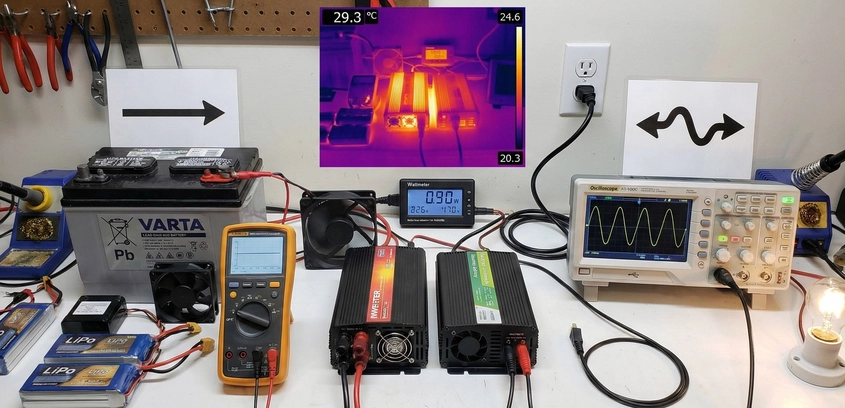
The Chemical Reality of ElectricityTo understand why your battery system needs heavy inverters and rectifiers, you have to go back to the atomic level. A battery works by shuffling ions from one material (Anode) to another (Cathode). This chemical shuttling creates a flow of electrons in one single direction. This is Direct Current (DC).The grid, however, powers your home with electrons that wiggle back and forth 50 or 60 times a second (Hertz). This is Alternating Current (AC). Bridging these two worlds is the primary challenge of modern energy storage.1. Why is the Grid AC? (Tesla vs. Edison)In the late 19th century, Thomas Edison pushed for DC grids. He failed. Nikola Tesla and Westinghouse pushed for AC. They won for one simple reason: Transformers.To transmit power over long distances, you need high voltage to minimize wire resistance losses. AC can be stepped up to 400,000V with a simple transformer, sent across the country, and stepped down to 110V/220V for your house. DC conversion was historically difficult and expensive (until modern HVDC). Thus, our entire appliance infrastructure was built around AC.2. The Conversion Tax: Efficiency LossesEvery time you change electricity from one form to another, you pay a tax in the form of Heat.AC to DC (Charging)Your "Charger" is technically a Rectifier. It takes the wiggling AC sine wave and forces it into a straight line to push into the battery. Typical Efficiency: 85% - 95%. Loss: If you pull 1000 Watts from the wall, only ~900 Watts make it into the battery. 100 Watts is lost as heat in the charger bricks.DC to AC (Inverting)Your Inverter takes the flat DC voltage and chops it up thousands of times a second (PWM) to simulate a sine wave. Typical Efficiency: 85% - 95%. Loss: To run a 1000W Microwave, you might pull 1150W from the battery.Round Trip Efficiency: If you charge from the grid and then power your home from the battery, you hit both taxes. $0.90 (Charge) imes 0.90 (Discharge) = 0.81$. You lose nearly 20% of your energy just in conversion. This is why DC-Coupled Solar Systems (where panels charge batteries directly) are far superior to AC-Coupled systems for off-grid efficiency.3. The Skin Effect and Wire SizingAC current has a peculiar behavior called the "Skin Effect." At higher frequencies, electrons tend to travel on the outer surface of the wire, ignoring the core. This effectively increases the resistance of the wire. DC current uses the entire cross-section of the wire evenly. This means for the same thickness of copper, DC can theoretically transmit power more efficiently over short distances (like inside a battery pack). However, because battery voltages are usually low (12V-48V), we still need massive cables to handle the raw Amperage.4. Safety: The Zero CrossingOne of the most dangerous aspects of high-voltage battery packs (EVs or large Powerwalls) is the lack of a "Zero Crossing."AC Shock: The voltage hits 0 Volts 100 or 120 times a second. If you grab a live wire, your muscles spasm, but that split-second zero point often gives your muscles a chance to release the grip.DC Shock: Constant pressure. If you grab a 400V DC line, your muscles lock tight (Tetanus), and you cannot let go. It cooks you.ArcingWhen you open a switch under load: AC: The arc extinguishes itself quickly because the voltage drops to zero ms later. DC: The arc sustains. It turns into a plasma torch. This is why you CANNOT use standard household light switches or breakers for battery systems. You must use DC-rated breakers equipped with magnetic arc chutes and snubber chambers.5. The Future: DC Homes?With the rise of LED lights (which are native DC), Solar (Native DC), and Computers (Native DC), there is a movement to wire homes with 48V DC backbones (USB-C PD outlets everywhere). This would eliminate the constant inversion/rectification losses. But until we replace the refrigerator and washing machine motors, we are stuck with the AC grid.SummaryYour battery is a DC island in an AC world. Understanding the cost of building bridges (inverters) between these worlds is critical for sizing your system. Always account for that 15-20% "Conversion Tax" when planning your solar array or backup generator runtimes.

28 Aug 2025 Read More
Energy Density: Gravimetric vs. Volumetric Battery Basics

Energy Density: Gravimetric vs. Volumetric

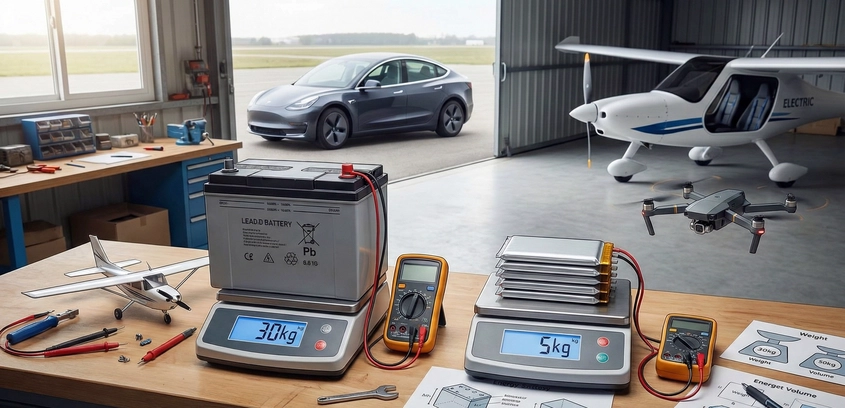
The Engineer's Trade-OffIn the world of battery design, there is no such thing as a "perfect" battery. There is only the right battery for the specific constraints of your project. When we talk about how "powerful" a battery is, we are usually discussing its Energy Density. However, this term is often used loosely to cover two very different physical constraints: Mass (Weight) and Volume (Space).Understanding the distinction between Gravimetric Energy Density (Wh/kg) and Volumetric Energy Density (Wh/L) is the single most important factor when selecting a chemistry for a specific application. A battery that is perfect for a forklift might be completely useless for a drone, even if they have the exact same capacity and voltage.1. Gravimetric Energy Density (Specific Energy)This metric answers the question: "How heavy is the fuel?"Measured in Watt-hours per Kilogram (Wh/kg), this is the holy grail for anything that fights gravity. Every gram of weight on a drone, an airplane, or a backpacker's gear requires energy to move. If the battery is too heavy, the energy it provides is wasted just carrying its own weight.The Chemistry Leaderboard (Weight)Lithium-Sulfur (Experimental): 500+ Wh/kg. The future of aviation, but currently suffers from low cycle life.NCA / NMC 811 (High-End Li-Ion): 250 - 300 Wh/kg. Used in Tesla vehicles and long-range drones. These are the kings of current commercial tech.LiPo (Cobalt): 150 - 200 Wh/kg. While powerful, the packaging (foil) is light, but the chemistry isn't as dense as cylindrical NMC.LFP (LiFePO4): 130 - 160 Wh/kg. Iron is heavy. This is why you rarely see LFP batteries in drones.Lead Acid: 30 - 40 Wh/kg. This is why electric cars didn't work in the 1990s. You would need a 4000lb battery to get the range of a 1000lb Lithium pack.2. Volumetric Energy DensityThis metric answers the question: "How big is the tank?"Measured in Watt-hours per Liter (Wh/L), this matters when space is limited but weight is less of a concern. Think about an electric vehicle chassis, a mobile phone, or a wearable medical device. You have a fixed cavity carved out of aluminum or steel; you need to cram as many electrons into that void as possible.The Form Factor FactorVolumetric density isn't just about chemistry; it is about geometry. Cylindrical Cells (18650/21700): When you stack cylinders together, there are unavoidable air gaps between them. Even with perfect hexagonal packing, you lose about 9-10% of the volume to air. This lowers the pack-level volumetric density, even if the cell chemistry is dense.Prismatic Cells: Large rectangular bricks. These stack with zero air gaps (aside from expansion tolerances). This allows for incredibly compact battery banks, making them ideal for Solar Powerwalls where the battery sits in a garage and weight is irrelevant.Pouch Cells: Similar to prismatic, these offer high packing efficiency but require external compression frames, which eat into the volume savings.3. Real World Scenarios: Picking Your FighterScenario A: The Long-Range Surveillance DroneConstraint: Gravity. Selection: You need maximum Wh/kg. You choose Panasonic NCR18650GA or LG MJ1 cells (NMC chemistry). Even though they take up space, they are light. Using LFP here would reduce flight time by 40% due to the weight penalty.Scenario B: The Tiny House Off-Grid SystemConstraint: A small utility closet. Selection: You need maximum Wh/L. You might choose NMC Prismatic modules from a wrecked EV. They pack a massive punch in a tiny footprint. However, if fire safety is more important than space, you accept the larger size of LFP because the building isn't moving.Scenario C: The Electric ForkliftConstraint: Counter-balance. Selection: Lead Acid. Yes, really. A forklift needs weight at the back to lift heavy pallets at the front. If you switched to Lithium, you would actually have to add steel ballast weights to the truck to keep it from tipping over. Here, low gravimetric density is actually a feature, not a bug.4. The Impact of Casing and AssemblyWhen calculating density, amateurs look at the cell datasheet. Professionals look at the "System Density."A raw cell might be 250 Wh/kg. But once you add:Copper BusbarsPlastic HoldersBMS & WiringSteel/Aluminum EnclosureCooling SystemThe final density usually drops by 20% to 40%. For example, the Tesla Model 3 battery pack (at the pack level) is roughly 160 Wh/kg, even though the individual cells are ~260 Wh/kg. This "packaging penalty" is the hardest part of battery engineering to optimize.5. The Future: Solid StateThe hype around Solid State Batteries (SSB) is driven almost entirely by Energy Density. By removing the liquid electrolyte and the graphite anode (replacing it with Lithium Metal), we theoretically jump to 400-500 Wh/kg and 1000+ Wh/L.This is the "Singularity" for electric aviation. At 500 Wh/kg, medium-haul commercial flights become physically possible. Until then, we are refining the packaging of NMC and NCA chemistries to squeeze every last drop of efficiency out of the existing technology.SummaryDon't just buy the "best" battery. Define your constraints. If it flies, count the grams. If it sits on a shelf, measure the inches. And if it needs to act as a counterweight, maybe the old heavy tech isn't so bad after all.

27 Aug 2025 Read More
Battery Cycle Life and How to Extend It Battery Basics

Battery Cycle Life and How to Extend It

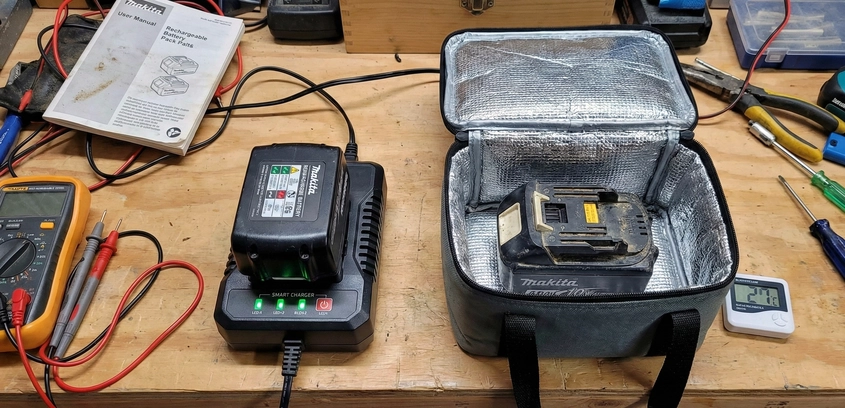
The Finite BucketEvery lithium-ion battery has a finite number of ions that can shuttle back and forth between the cathode and anode. We call this "Cycle Life." Manufacturers often rate a cell for "500 Cycles" or "2000 Cycles." But what does that mean? And why does one user get 3 years out of a pack while another gets 10?Degradation is not magic; it is chemistry. It happens in two distinct ways: Cyclic Aging (Wear from use) and Calendar Aging (Wear from time).1. What is a "Cycle"?A common myth is that charging your battery from 90% to 100% counts as "one cycle," just like charging from 0% to 100%. This is false. A Cycle is defined as the discharge of 100% of the battery's capacity, whether it happens in one go or over several days. Example: Day 1: Use 50%, Charge to Full. Day 2: Use 50%, Charge to Full. Total: This counts as One Cycle, not two.2. The Knee of the Curve (EOL)When a manufacturer says "Rated for 500 Cycles," they do not mean the battery stops working at cycle 501. They mean that at cycle 500, the battery will have 80% of its original capacity remaining. This is called End of Life (EOL). A battery is usually usable after EOL, but the degradation accelerates. The internal resistance rises, causing voltage sag, and the capacity drops off a cliff (the "Knee").3. Depth of Discharge (DoD): The Longevity HackThe deepest secret in battery engineering is that lithium hates deep cycles. Discharging a battery from 100% down to 0% (100% DoD) puts massive mechanical stress on the graphite anode structure. The anode physically expands and contracts, causing micro-cracks.The Data (NMC Chemistry):100% DoD (4.2V -> 2.8V): ~500 Cycles to EOL.80% DoD (4.1V -> 3.0V): ~1,500 Cycles to EOL.50% DoD (4.0V -> 3.4V): ~5,000+ Cycles to EOL.By simply sacrificing the top 10% and bottom 10% of your capacity (using the middle 80%), you can triple the lifespan of your battery. This is why hybrid cars (Prius) last 10+ years; they only use the middle 40% of the battery.4. Calendar Aging: The Heat FactorEven if you never use the battery, it degrades. This is Calendar Aging. The primary driver here is Temperature and State of Charge (SOC).The electrolyte inside the cell slowly reacts with the electrodes to form a Solid Electrolyte Interphase (SEI) layer. This layer gets thicker over time, increasing resistance (impedance). Arrhenius Equation: For every 10°C increase in temperature, the reaction rate doubles. Storing a fully charged battery (100% SOC) in a hot car (40°C) is the fastest way to kill it. In one month, it can lose as much health as 100 driving cycles.Storage Solution: If you aren't using the battery for a week, discharge it to 50% (3.8V) and store it in a cool place (15°C). See our Storage Guide.5. C-Rate ImpactPushing a battery hard generates heat. Fast charging (1C+) or heavy discharging forces ions into the anode faster than they can intercalate. This causes Lithium Plating. Rule: A battery cycled gently at 0.5C will last significantly longer than one cycled at 3C. Oversizing your battery bank not only gives you more range but reduces the strain on each individual cell, extending life.6. Practical Tips for DIYersSolar Banks: Size your bank so you only use 20-30% of it overnight. This keeps you in the shallow DoD range, allowing LiFePO4 batteries to last 15+ years.E-Bikes: Charge to 80% (4.0V/cell) for daily commutes. Only charge to 100% when you absolutely need the full range.Laptops/Phones: Unplug when full. Keeping it at 100% and hot is bad.SummaryBattery life is not a lottery; it is a resource you spend. You can spend it quickly with deep cycles, heat, and full charges, or you can stretch it out over decades by staying in the "Goldilocks Zone" of voltage and temperature.

26 Aug 2025 Read More
Watt-Hours (Wh) vs. Amp-Hours (Ah) Explained Battery Basics

Watt-Hours (Wh) vs. Amp-Hours (Ah) Explained

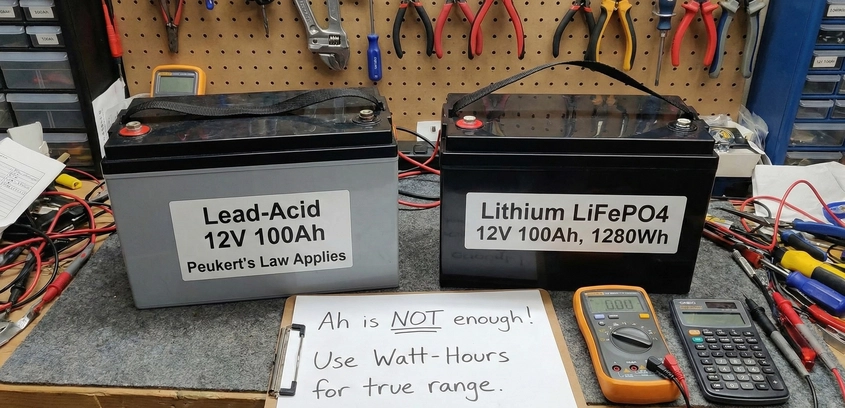
The Water Tank AnalogyIn the world of portable power, two units dominate the conversation: Amp-Hours (Ah) and Watt-Hours (Wh). While they both measure "capacity," they are not interchangeable. Confusing them can lead to dangerous system mismatches or disappointing runtimes.To simplify, let's use the water analogy:Amp-Hours (Ah): This is the Volume of water in the tank. A 100Ah tank holds "100 units" of electrons.Voltage (V): This is the Height of the tank (Pressure).Watt-Hours (Wh): This is the Potential Energy (Work) that the water can perform when it hits the bottom.A bucket of water (10Ah) dropped from 1 foot (1V) does very little work. That same bucket dropped from 1000 feet (1000V) can crush a car. This is why looking at Ah without knowing the Voltage is meaningless.1. The Formula for TruthThe relationship is governed by the Power formula:Watt-Hours (Wh) = Amp-Hours (Ah) × Voltage (V)This formula allows you to compare apples to oranges. Let's look at a common confusing scenario.Case Study: The "20,000mAh" Power BankYou see a USB power bank on Amazon advertised as "20,000mAh" (20Ah). You also have a small 12V 7Ah motorcycle battery. A novice might think: "The Power Bank has 20Ah, the motorcycle battery has 7Ah. The Power Bank is 3x bigger!"Let's do the Math (Wh):USB Bank: The cells inside are 3.7V. $20Ah imes 3.7V = 74 Wh$.Motorcycle Battery: The cells are 12V. $7Ah imes 12V = 84 Wh$.The motorcycle battery actually contains more energy, despite having a much lower Ah number. The marketing department uses the cell voltage (3.7V) to inflate the Ah number, but the work is done by the total Watt-Hours.2. Why Airlines Care About WhHave you ever noticed the TSA limit for batteries is 100Wh? They don't list an Amp-Hour limit. This is because a 100Ah battery at 1.2V (NiMH) is fairly safe. A 100Ah battery at 50V (Lithium) is a bomb. Watt-Hours represents the total chemical energy stored that could be released in a fire. To check if your drone battery is legal to fly: $14.8V (4S) imes 5Ah = 74Wh$. (Safe to fly).3. Comparing Voltage Systems (12V vs 24V vs 48V)When designing a solar bank, you have a choice of voltage. Let's say you need to store 5000 Watt-Hours (5kWh) of energy.At 12V: You need 416 Amp-Hours. (Requires massive 4/0 cables).At 48V: You need 104 Amp-Hours. (Requires standard 4 AWG cables).Both banks store the same energy. Both will run your TV for the same amount of time. But the 48V system is more efficient because it moves that energy at higher pressure and lower flow (Amps), reducing heat loss in the wires. See our Ohm's Law Guide for more on this.4. The Lead Acid Lie: Peukert's LawAh ratings on Lead Acid batteries are often misleading due to a phenomenon called Peukert's Effect. Lead Acid capacity is rated at a "20-hour rate" (C/20). A 100Ah lead battery will give you 100Ah only if you drain it slowly over 20 hours (5 Amps).If you drain that same battery in 1 hour (100 Amps), you won't get 100Ah. You might only get 55Ah. The internal resistance wastes nearly half the energy as heat.The Lithium Advantage: Lithium has a Peukert constant very close to 1.0. A 100Ah Lithium battery will give you ~100Ah whether you drain it in 20 hours or 1 hour. This is why a "100Ah" Lithium battery effectively replaces a "200Ah" Lead Acid battery in high-power applications. You get the usable energy you paid for.5. Calculating Your RequirementsWhen sizing a battery bank, ignore Ah initially. Calculate your daily load in Watt-Hours.Refrigerator: 50 Watts x 24 hours = 1200 WhLaptop: 60 Watts x 4 hours = 240 WhLights: 10 Watts x 5 hours = 50 WhTotal Daily Energy: 1490 WhNow you can shop for batteries. You need a battery with >1490Wh usable capacity. If buying a 12V battery: $1490Wh / 12V = 124Ah$. If buying a 24V battery: $1490Wh / 24V = 62Ah$.SummaryAmp-Hours are useful for matching cells within a specific voltage platform. But Watt-Hours are the truth. Whenever you are comparing batteries of different voltages, chemistries, or form factors, always convert to Watt-Hours to see the real value.

24 Aug 2025 Read More