
Latest Articles

Page 8 of 10
Insulation Guide: Fishpaper, Kapton, and Short Prevention Battery Design & Assembly

Insulation Guide: Fishpaper, Kapton, and Short Prevention

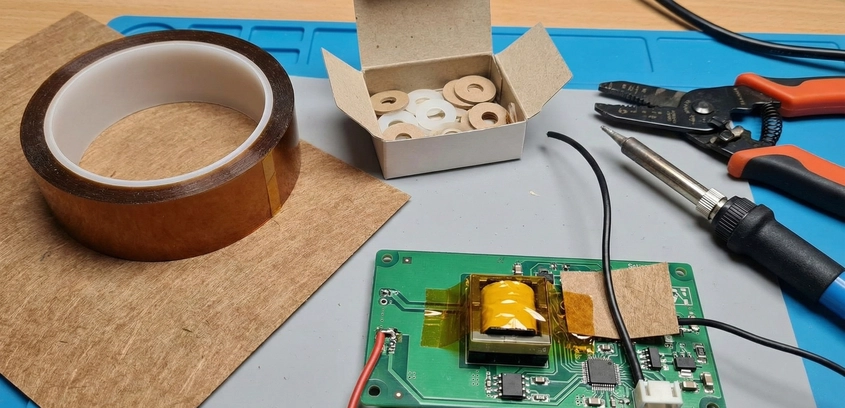
The Thin Line Between Power and PlasmaWhen you hold an 18650 cell in your hand, you are holding a potential bomb wrapped in a thin layer of plastic. Most beginners look at a battery and see a Positive top and a Negative bottom. This is a fatal oversimplification.The entire metal casing of a cylindrical cell—the sides, the bottom, and crucially, the curved "shoulder" right next to the positive button—is Negative. The only thing separating the Positive terminal from the Negative can at the top of the cell is a tiny, 0.2mm gap and a flimsy piece of heat-shrink PVC.This guide focuses on the single most critical safety step in battery assembly: Supplemental Insulation. If you skip this, vibration will eventually turn your battery into a flare.1. The "Guillotine" EffectWhy do packs fail after 6 months of riding? Vibration.When you spot weld a nickel strip to the positive terminal, that strip must travel across the top of the cell to connect to the next group. It lays directly over the "shoulder" of the cell—the sharp metal rim of the negative can.The Mechanism of Failure: 1. You weld the strip. It is tight against the cell top. 2. You ride your e-bike. The battery vibrates thousands of times a minute. 3. The sharp edge of the negative can (the shoulder) acts like a knife (a guillotine) rubbing against the underside of the nickel strip. 4. The only barrier is the cell's original PVC wrap. PVC is soft. It wears through. 5. BOOM. The nickel strip (Positive) touches the Can Edge (Negative). This is a dead short circuit with zero resistance. The nickel glows white-hot instantly, igniting the electrolyte.2. Material Science: Fishpaper (Vulcanized Fiber)To prevent the guillotine, you need a material that is tough, heat-resistant, and dielectric. Enter Fishpaper (also known as Barley Paper).What is it? It is a cotton-based paper that has been chemically treated (vulcanized) with zinc chloride. This process gelatinizes the cotton fibers, fusing them into a dense, non-laminated solid.Why use it? Unlike plastic tape, Fishpaper does not melt when you solder or spot weld near it. More importantly, it has incredible Abrasion Resistance. It is almost impossible for a dull metal edge to cut through it under vibration. It creates a physical shield over the negative shoulder of the cell.Mandatory Application: You MUST place a self-adhesive Fishpaper Ring (Insulator Ring) on the positive terminal of every single cell before spot welding. This adds a second, tougher layer of defense on top of the factory PVC.3. Material Science: Kapton Tape (Polyimide)You will see rolls of translucent yellow tape on every battery builder's bench. This is Polyimide tape, commonly referred to by the DuPont brand name "Kapton."Properties: - Heat Resistance: Withstands 400°C. You can solder right through it without it melting. - Dielectric Strength: Extremely high voltage insulation per micrometer. - Thinness: Usually only 0.05mm thick.The Trap: Kapton is amazing at stopping electricity and heat, but it is mechanically weak against puncture. A sharp point will poke right through it. Do NOT use Kapton to prevent the Guillotine Effect. The cell shoulder will slice through Kapton easily. Use Kapton to hold wires in place, to wrap the final pack, or to insulate flat surfaces. Use Fishpaper for sharp edges.4. The Layered Defense StrategyA professional pack uses insulation in specific layers:Layer 1: The RingApply a Fishpaper ring to every cell Positive terminal. This is non-negotiable. If you buy Recycled Cells, the original PVC is likely damaged, making this ring even more vital.Layer 2: Series Crossing ShieldsIn a 10S or 13S battery, the nickel strips carry increasingly different voltages. If a nickel strip from Group 1 (3.6V) crosses over Group 5 (18V), and they touch, you have a short. Wherever a series connection crosses a cell or another strip, place a rectangular strip of Fishpaper underneath the nickel to act as a bridge.Layer 3: Group IsolationIf you are folding your battery (e.g., gluing two rows back-to-back to make it thicker), you must put a full sheet of Fishpaper or thin Fiberglass sheet between the groups. Relying on the cell shrink wrap to separate 40V potential differences is gambling. Friction will eventually wear the PVC down.Layer 4: Final WrapBefore putting the blue PVC heat shrink on the whole pack, wrap the entire assembly in a layer of Fishpaper or thick fiber tape. This protects the BMS sense wires and main discharge cables from rubbing against the sharp edges of the nickel strips on the outside of the pack.5. Liquid Electrical Tape and SiliconesCan you use liquid insulation? Liquid Electrical Tape: Good for waterproofing lug crimps, but useless for mechanical protection inside a battery. It rubs off too easily. RTV Silicone: Excellent for potting and vibration dampening. Use Neutral Cure silicone to glue cells into holders or to secure heavy wires so they don't wiggle. Preventing movement is a form of insulation because if it can't move, it can't rub.6. The "Spark" Test (Don't do it)Some people think, "I'll just be careful." Try this mental exercise: Imagine your battery is in a paint shaker for 5 years. That is what an e-bike battery experiences on the road. "Careful" assembly doesn't stop physics. Abrasion is inevitable. If you disassemble a 3-year-old commercial battery (like a Bosch or Shimano), you will see plastic cages, paper separators, and silicone potting everywhere. They don't rely on luck. They rely on physical separation.Summary for the BuilderInsulation is cheap. A sheet of Fishpaper costs $1. A roll of Kapton costs $5. A battery fire costs your home. Rule of Thumb: If metal crosses metal, put paper between them. If metal touches a cell edge, put a ring on it. Never trust PVC shrink wrap to save your life.

23 Sep 2025 Read More
Cell Holders vs. Glue: Structural Assembly Methods Battery Design & Assembly

Cell Holders vs. Glue: Structural Assembly Methods

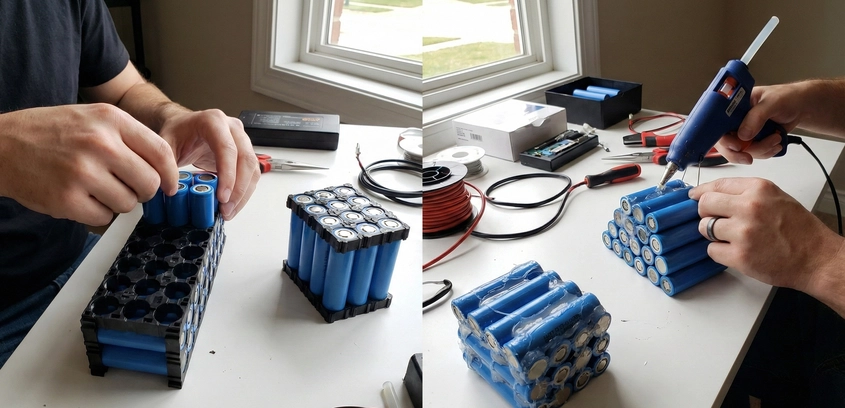
The Skeleton of Your Power PlantWhen you build a battery pack, you aren't just wiring cells together; you are building a structural brick. This brick must survive road vibrations, thermal expansion, and potential impacts. The method you use to hold the cells together—the chassis—dictates the longevity and safety of the entire system.There are two main schools of thought: 1. The Glue Method: Using hot glue or silicone to stick cells directly to each other. 2. The Holder Method: Using injection-molded ABS or Polycarbonate spacers.While glue was common in the early days of DIY e-bikes (and still used in some cheap consumer goods), professional engineering standards have largely moved to holders. Let's analyze why.1. Thermal Management: The Air GapThe Holder Advantage: Standard 18650/21700 cell holders are designed to keep the cells roughly 1mm to 2mm apart. They do not touch. This creates a matrix of air channels throughout the entire pack. Physics: Air is an insulator, yes, but it also allows for convection. More importantly, the plastic holder prevents cell-to-cell thermal conduction. If one cell gets hot, it doesn't immediately heat soak its neighbor through direct contact.The Glue Disadvantage: When you glue cells in a honeycomb pattern, they touch each other. You fill the triangular gaps with glue. This creates a solid thermal mass. The Consequence: The cells in the center of the pack have nowhere to shed heat. They bake. Since heat degrades lithium chemistry (Arrhenius effect), the center cells die faster than the outer cells. This imbalance leads to a pack that drifts out of balance constantly.2. Structural Integrity and VibrationThe Glue Problem: Hot glue is a thermoplastic. It softens when warm. Imagine your e-bike battery running hard on a summer day. The cells reach 50°C. The glue softens. You hit a pothole. The bond breaks. Now you have a loose cell rattling around inside the pack. This loose cell will tug on the nickel strip spot welds. Eventually, the metal fatigues and snaps, disconnecting the cell or causing an arc fault.The Holder Solution: ABS plastic holders are rigid up to 100°C. They lock the cells into a unified grid. When the bike hits a bump, the entire grid moves as one unit. There is no relative motion between cells, meaning zero mechanical stress on the nickel strips.3. Thermal Runaway PropagationThis is the most critical safety factor. If a single cell fails catastrophically and goes into Thermal Runaway, it can reach 600°C+.Glue Pack: The failing cell is physically touching 6 other cells. Heat transfer is conductive and instantaneous. The neighbors heat up and fail within seconds. The entire pack goes up in a chain reaction.Holder Pack: The failing cell is separated by an air gap and a layer of fire-retardant plastic (if using UL-rated holders). This delay prevents or slows down the propagation, giving you time to get the pack off the bike or out of the house.4. When is Glue Acceptable?Despite the downsides, glue has one massive advantage: Size. Plastic holders add about 2mm to 4mm to the dimensions of the pack in every direction. If you are trying to fit a battery inside a tight downtube or a weirdly shaped triangular frame bag, holders simply might not fit.The "Safe" Glue Protocol: If you must go clipless: 1. Do NOT use Hot Glue. It is brittle in cold and soft in heat. 2. Use Neutral Cure Silicone (RTV). Use a dedicated electronic-grade silicone (like Dow Corning 7091). It remains flexible, handles high heat, and adheres incredibly well. 3. Insulate: You must create spacing. Use strips of Fishpaper or Barley paper between the cell rows before gluing. Never glue metal can to metal can directly; vibration will wear through the shrink wrap and cause a short.5. 3D Printed HoldersIf commercial rectangular holders don't fit your shape, you can 3D print custom ones. Material Choice: Do not use PLA. It softens at 60°C (inside a car in summer). Use PETG or ABS. Design the holders with "fillets" to avoid sharp edges cutting the cell wrap. This allows you to build curved packs or weird shapes while maintaining the safety benefits of a rigid frame.Engineering VerdictHolders are the industry standard for a reason. They provide mechanical locking, thermal isolation, and electrical safety spacing. Gluing is a compromise born of necessity (space constraints). If you have the room, always use holders. If you must glue, use industrial silicone and mechanical spacing layers, and accept that the thermal life of the pack will be reduced.

21 Sep 2025 Read More
Busbar Design for High Current Applications Battery Design & Assembly

Busbar Design for High Current Applications

When Nickel Becomes a ResistorIn the world of battery building, pure nickel strip is the standard. It is easy to weld, resists corrosion, and is relatively cheap. But nickel has a dirty secret: it is a mediocre conductor. Pure nickel has roughly 20% of the electrical conductivity of copper (IACS rating).For a standard 30A e-bike battery, nickel is fine. But what happens when you build a 72V performance battery pulling 150 Amps? Or a Powerwall dumping 200 Amps into an inverter? If you use nickel strips, you aren't building a conductor; you are building a toaster oven. The resistance generates massive heat ($I^2R$), causing voltage sag and potentially melting the cell shrink wrap.To handle high current, we must use Copper. But copper is notoriously difficult to spot weld. It is so conductive that it dissipates the welder's heat faster than it can melt. This guide explores the engineering solution to this problem: The Resistance Sandwich technique.1. The Physics of ConductivityLet's look at the numbers. The resistance of a metal strip is determined by its material resistivity and its cross-sectional area.Pure Nickel Resistivity: ~69 nΩ·mPure Copper Resistivity: ~17 nΩ·mThis means a strip of copper is 4 times more conductive than an identical strip of nickel. To match the current-carrying capacity of a 0.1mm copper sheet, you would need a 0.4mm thick nickel sheet. Welding 0.4mm nickel is nearly impossible for most hobbyist welders. Using copper allows us to keep the profile thin while quadrupling the ampacity.2. The Welding ChallengeWhy don't we just spot weld copper directly to the 18650 steel can? Thermal Diffusivity. Spot welding relies on contact resistance generating heat to melt the metals together. Steel and Nickel have relatively high resistance, so they get hot quickly. Copper has almost zero resistance. When you dump 1000 Amps into copper, it stays cool, but the heat spreads instantly to the surrounding area. Furthermore, copper does not alloy easily with the steel of the battery terminal. The result is a weak, "sticky" weld that pops off under vibration.3. The Solution: The Copper-Nickel SandwichThis technique uses a layer of nickel to "trick" the welder and bond the copper to the cell.The Stack:Battery Terminal: The base (Steel).Nickel Strip (Bottom): A standard 0.15mm nickel strip sits directly on the cell.Copper Sheet (Middle): Your high-current busbar (e.g., 0.1mm or 0.2mm copper).Nickel Cap (Top): A small square of nickel placed on top of the copper at the weld point.How it Works: When the weld probes touch the top Nickel Cap, the high resistance of the nickel generates intense localized heat. This heat is trapped because it has to travel through the copper to get to the bottom nickel layer. The stack gets hot enough to fuse the Top Nickel, the Copper, and the Bottom Nickel/Steel into one solid nugget. The nickel acts as the "brazing material" or glue, holding the highly conductive copper firmly to the cell terminal.4. Alternative: The "Slotted Copper" MethodIf you have a high-power welder (like a kWeld or industrial pneumatic head), you can sometimes skip the sandwich and weld copper directly IF you use a specialized design.The Slot: You must cut a slot in the copper strip between the two weld points. This forces the welding current to travel down into the battery can (steel) and back up, rather than just shorting across the top of the copper. The Electrode: You typically need Tungsten electrodes (which don't stick to copper) instead of standard copper electrodes.5. Sizing Your Busbar: The MathHow wide should your copper be? "Ampacity" depends on the allowed temperature rise. For batteries, we want minimal heat (less than 10°C rise).Rule of Thumb for 0.1mm Copper Sheet: - 10mm wide: ~30 Amps continuous. - 20mm wide: ~60 Amps continuous. - 30mm wide: ~90 Amps continuous.Rule of Thumb for 0.2mm Copper Sheet: - 10mm wide: ~55 Amps continuous. - 20mm wide: ~110 Amps continuous.If you are building a 200A drag racing pack, you might need to stack two layers of 0.2mm copper x 30mm wide. Always oversize your busbars. The lower the resistance, the less voltage sag you will experience under load.6. Flexible Busbars for VibrationRigid copper sheet has a downside: it doesn't flex. If your battery pack is in a skateboard or a vibrating vehicle, rigid busbars can crack the spot welds or tear the battery terminals over time.The Solution: Braided Copper or Laminated Foil. Instead of a solid sheet, use flat braided copper grounding straps or multiple layers of ultra-thin (0.05mm) foil. This allows the busbar to absorb vibration and thermal expansion without stressing the weld joints. This is mandatory for Prismatic Cell modules where the terminals can move significantly.7. Insulation and SafetyA copper busbar is a massive exposed conductor. If you drop a wrench on it, the arc explosion will be blinding. 1. Fishpaper: Place adhesive fishpaper rings on every cell positive terminal before welding the sandwich. 2. Kapton Tape: After welding, cover the entire busbar with Kapton tape or a plastic shield. 3. Cell Level Fusing: For massive parallel groups, consider using fuse wire for the final connection to the busbar instead of a direct weld. If one cell shorts, the busbar has enough energy to explode that cell. A fuse wire isolates the problem.Engineering RealityThe Copper-Nickel Sandwich is the industry standard for high-performance DIY packs. It combines the weldability of nickel with the conductivity of copper. It requires more preparation time and a powerful welder, but the result is a pack that runs ice-cold even when pushing limits that would turn a standard nickel pack into a heater.

21 Sep 2025 Read More
Spot Welding vs. Soldering Lithium Cells Battery Design & Assembly

Spot Welding vs. Soldering Lithium Cells

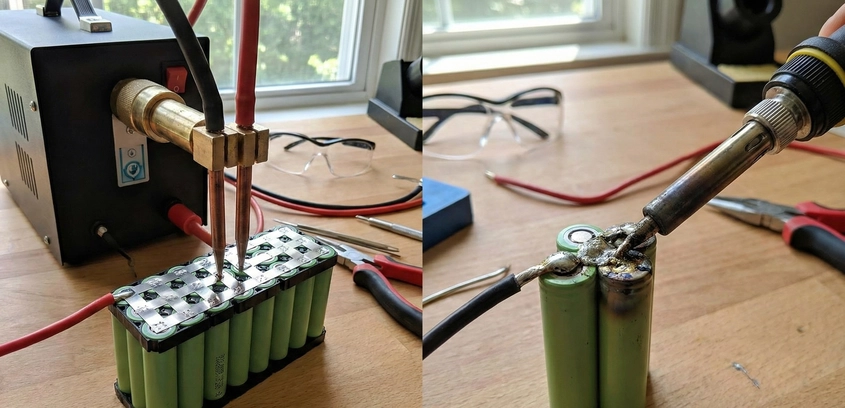
The Temptation of the IronWe get it. A good spot welder costs $200+. You already have a soldering iron. It seems like an easy way to save money. You might have even seen YouTube videos of people soldering packs "successfully."However, "it works" and "it is safe" are two very different things. Soldering cells is widely regarded as malpractice in the battery industry. To understand why, we have to look inside the metal can.1. Anatomy of the Positive TerminalThe Button Top (Positive) of an 18650 is not just a piece of metal connected to the chemistry. It is a complex assembly containing:The Vent Disc: A thin metal foil designed to rupture if pressure gets too high.The CID (Current Interrupt Device): A mechanical fuse that disconnects the cell if internal pressure pushes the vent disc up.The PTC (Positive Temperature Coefficient): A thermal resistor that limits current if the cell gets too hot.The Gasket (Seal): A plastic (polymer) ring that insulates the positive pole from the negative can and keeps the liquid electrolyte inside.The Failure MechanismWhen you apply a soldering iron to the positive terminal, you are dumping massive amounts of heat into it. To get solder to flow on a large metal surface, you typically need to hold the iron there for 5-10 seconds. This heat travels instantly down the terminal assembly. The Gasket Melts: The plastic seal softens and deforms. This compromises the airtight seal of the cell. The Electrolyte Dries Out: Over the next 6-12 months, the volatile solvent inside the cell slowly evaporates through the compromised seal. The cell's Internal Resistance rises. Capacity drops. Eventually, the cell dies prematurely.2. Anatomy of the Negative TerminalThe bottom of the can is the Negative terminal. It is usually thinner metal. Directly on the other side of that thin steel floor is the Anode Roll and the Separator.The Separator Danger: The plastic separator (polyethylene/polypropylene) melts at roughly 130°C - 160°C. Molten solder is over 300°C. If you solder the negative terminal, you risk melting the separator directly underneath the weld spot. This creates a "Latent Defect"—a microscopic weak point in the insulation between anode and cathode. It might not short out today. But after 50 charge cycles, that weak spot creates a dendrite path, leading to an internal short and thermal runaway.3. The Physics of Spot Welding (Resistance Welding)Why is spot welding safe? It uses Joule Heating focused on a microscopic point. A spot welder dumps a massive current (e.g., 1000 Amps) for a tiny duration (e.g., 10 milliseconds). Formula: $Heat = I^2 imes R imes t$.Because the duration ($t$) is so short, the total heat energy is low, but the intensity at the contact point is high enough to melt metal. Crucially, the heat is generated at the interface between the nickel strip and the battery terminal. The heat fuses the metals instantly and dissipates into the mass of the battery before it can travel to the delicate internal components. You can touch a spot weld with your finger 2 seconds after welding; it will be warm, not hot. A soldered joint stays hot for minutes.4. Equipment: What You NeedIf you are committed to building a pack, you have two options:The "Joule" Welder (Capacitor/Battery Based)Examples: kWeld, Malectrics. These use a massive discharge from a car battery or supercapacitor bank. They measure the energy delivery in Joules. They are consistent, powerful, and capable of welding 0.2mm or even 0.3mm pure nickel. This is the pro-sumer standard.The Transformer Welder (AC Grid Based)Examples: Sunkko 709A. These plug into the wall. They are heavy and less consistent because they depend on your AC line voltage (which sags). They often struggle with 0.2mm pure nickel, forcing you to use plated steel (which has high resistance). They are "okay" for small hobby packs but frustrating for large builds.5. The Pull Test: Verifying Your WeldsHow do you know if your weld is good? Do a sacrificial test. Weld a strip to a scrap cell. Then, grab the strip with pliers and rip it off. Bad Weld: The strip pops off cleanly. The battery terminal is smooth. Good Weld: The strip tears, leaving chunks of nickel attached to the battery terminal. This "tearing out" indicates the weld was stronger than the metal strip itself.SummarySoldering is for wires. Spot welding is for cells. The initial cost of a spot welder ($100-$200) is cheaper than the cost of replacing a ruined battery pack or repairing fire damage. Respect the chemistry; keep the heat away.

20 Sep 2025 Read More
Nickel Strip Selection: Pure Nickel vs. Plated Steel Battery Design & Assembly

Nickel Strip Selection: Pure Nickel vs. Plated Steel

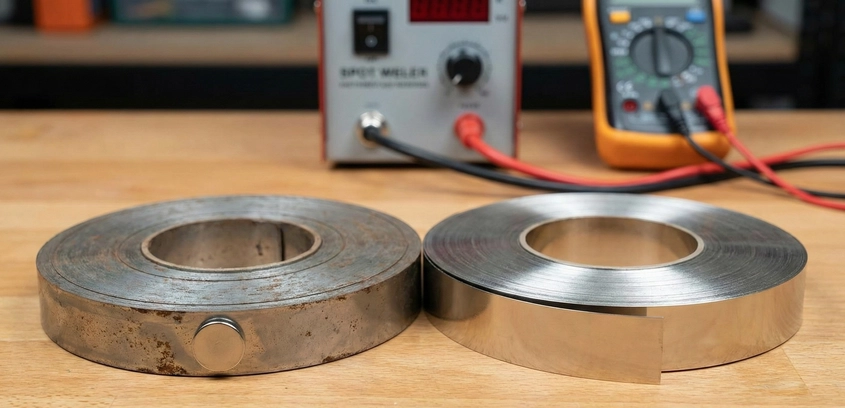
The Weakest Link in the ChainYou have spent hundreds of dollars on high-quality Samsung or Molicel cells. You have bought a Smart BMS. You have 3D printed a custom enclosure. But if you connect it all together with the wrong metal strips, you have built a fire hazard, not a battery.The metal strips used to connect battery cells are the highway for electrons. If the highway is too narrow (wrong thickness) or made of the wrong material (steel vs. nickel), traffic jams occur. In electronics, a traffic jam manifests as Resistance, and resistance creates Heat.The market is flooded with "Pure Nickel" strips that are actually nickel-plated steel. This guide will arm you with the physics, the math, and the forensic testing methods to ensure you are getting what you paid for and building a pack that can handle the amps.1. The Physics: Nickel vs. SteelWhy do we use Nickel? Why not Copper or Steel? Copper: Excellent conductor, but extremely difficult to spot weld to steel battery terminals (requires massive power). Aluminum: Cannot be spot welded to steel easily. Steel: Easy to weld, cheap, but terrible conductor. Nickel: The "Goldilocks" metal. It welds easily to steel cans, resists corrosion, and has acceptable conductivity.Resistivity ComparisonResistivity is the inherent resistance of a material per meter.Pure Nickel (99.6%): ~69.3 nΩ·m (Nano-ohm meters).Steel (Low Carbon): ~160 - 200 nΩ·m.The Reality: Steel has roughly 3 to 4 times the resistance of Pure Nickel. If you build a high-power e-bike battery using steel strips instead of nickel, the strips will generate 4x more heat for the same current. Under heavy load, steel strips can glow red hot, melt the plastic shrink wrap on the cells, and cause a direct short circuit between the positive terminal and the negative can.2. The Forensic Toolkit: Identifying FakesChinese marketplaces are notorious for selling "99.96% Pure Nickel" that is actually plated steel. You cannot tell by looking at it. Both are shiny and silver. You must test.Test A: The Salt Water Test (Definitive)1. Take a sample of your strip. 2. Scratch the surface deeply with a knife or sandpaper to expose the core. 3. Submerge it in a glass of salty water. 4. Wait 24-48 hours.Results: If it is Pure Nickel, it will look exactly the same. Nickel is highly corrosion-resistant (used in plating for this reason). If it is Plated Steel, the scratch will be covered in red rust. The salt water attacked the exposed iron core.Test B: The Spark Test (Fast)Take a Dremel tool or a bench grinder. Touch the strip to the grinding wheel. Steel: Throws a shower of bright, branching sparks. Pure Nickel: Throws very few, short, dull-orange sparks. It feels "softer" on the wheel.Test C: The Fold TestFold the strip in half. Pure nickel is malleable and soft; it folds easily. Steel is stiffer and has a "springy" feel.3. Sizing Your Strips: The Ampacity MathOnce you have verified you have Pure Nickel, you need to determine how much current it can carry. "Ampacity" is not a fixed number; it depends on how hot you are willing to let the strip get.Standard Strip Dimensions: 0.15mm thick x 8mm wide. Cross Sectional Area: $0.15 imes 8 = 1.2 mm^2$.Current Limits (Pure Nickel):0.15mm x 8mm: ~7 Amps continuous (cool). ~10 Amps (warm).0.20mm x 8mm: ~10 Amps continuous (cool). ~14 Amps (warm).0.15mm x 25mm (Wide Sheet): ~20 Amps continuous.The Series BottleneckThis is where beginners fail. In a Series Connection, the entire current of the pack flows through the series bridges. Example: You are building a 50A continuous e-bike battery (14S5P). Your Parallel connections only handle local balancing currents (low). But the connection between Group 1 and Group 2 must handle the full 50 Amps.If you use a single 0.15mm strip for the series connection, you are pushing 50A through a strip rated for 7A. It will act like a fuse and blow instantly. The Solution: You need roughly $50A / 7A approx 7$ strips. Obviously, you can't weld 7 strips. Instead, you must use:Series Stacking: Weld 2 or 3 layers of 0.20mm nickel on top of each other.Copper Reinforcement: Solder copper wire or copper sheet on top of the nickel strip to carry the bulk of the load.4. Slotted vs. Solid StripsYou will often see nickel strips with a slit cut down the middle over the weld point. This is not for weight reduction; it is for Weld Quality.When you use a spot welder, the current flows from one probe to the other. Solid Strip: Much of the current flows through the top of the nickel strip directly between the probes, without penetrating down into the battery can. This is a "shunt." It creates a weak weld. Slotted Strip: The slot forces the current to travel down into the battery terminal and back up to the other probe to get around the gap. This deeper current path creates a much stronger weld nugget.5. The Danger of "Ladder" StripsMany vendors sell pre-cut "Ladder" nickel (a long roll with rungs). Pros: Fast to assemble. Keeps spacing consistent. Cons: Often made of thinner/lower quality nickel. Fixed spacing means you cannot adjust for cell holder tolerances. But the biggest risk is ampacity. The "rung" of the ladder is often the bottleneck. Calculate the width of the series connection part of the ladder carefully. If the bridge is only 6mm wide, de-rate your ampacity accordingly.Final Rules for the Builder1. Trust nothing. Salt test every new roll of nickel you buy, even from trusted vendors. Supply chains get contaminated. 2. Over-build. If you calculate you need 2 layers of nickel, use 3. Resistance is the enemy of efficiency. 3. Insulate. Nickel strips are sharp. If a series strip crosses over a cell shoulder, put a layer of Fishpaper underneath it to prevent it from slicing through the cell wrap.

19 Sep 2025 Read More
Chemistry Safety: Thermal Runaway and Fire Propagation Cell Types & Chemistry

Chemistry Safety: Thermal Runaway and Fire Propagation

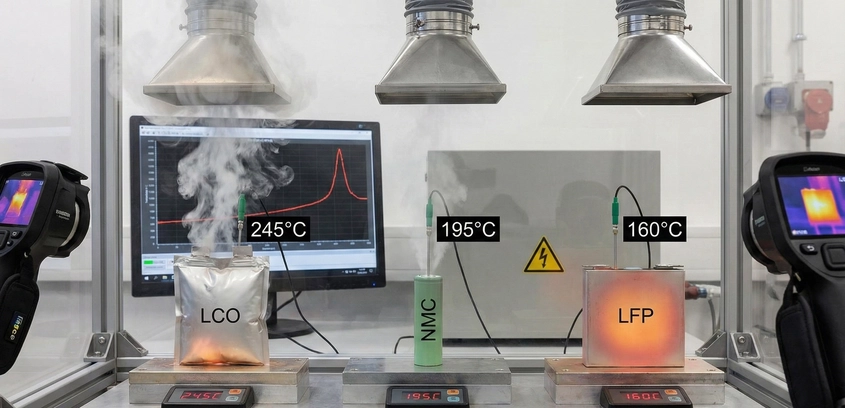
The Point of No ReturnWe often use euphemisms like "venting" or "rapid disassembly." Let's be precise: Thermal Runaway is an unstoppable, exothermic positive feedback loop. Once it starts, the battery generates its own heat faster than it can dissipate it, leading to the complete destruction of the cell and potentially everything around it.Understanding the specific temperature triggers for different chemistries is not just academic; it dictates how you design your cooling system, where you place your thermal probes, and where you store your batteries.1. The Anatomy of a Battery FireFire requires the "Fire Triangle": Fuel, Heat, and Oxygen. A lithium battery contains all three inside its sealed can.Fuel: The liquid electrolyte (organic solvents like Ethylene Carbonate) and the Anode (Graphite).Heat: Generated by an internal short circuit (dendrite) or external abuse (overcharging).Oxygen: This is the killer. The Cathode material (the positive side) is an oxide (Lithium Cobalt Oxide, etc.). When it gets hot enough, the chemical bond holding the oxygen breaks.Once the cathode releases oxygen, it mixes with the boiling electrolyte vapor. This mixture auto-ignites. Because the oxygen is coming from inside the reaction, you cannot smother this fire with a fire blanket or foam. It will burn until the chemical fuel is exhausted.2. Critical Temperature ThresholdsThe "Runaway Temperature" is the point where the cathode crystal structure collapses and releases oxygen. This threshold varies wildly by chemistry.Lithium Cobalt Oxide (LCO)Found in: Old laptops, some RC LiPos, older phones.Runaway Temp: ~150°C (302°F).Reaction: Extremely violent. LCO releases a massive amount of energy and oxygen very quickly. It is the least stable chemistry.Nickel Manganese Cobalt (NMC / NCA)Found in: Tesla, E-Bikes, Power Tools, Modern Drones.Runaway Temp: ~170°C - 210°C (338°F - 410°F).Reaction: High violence. Jet-flames are common. The high energy density means there is a lot of fuel packed into a small space.Lithium Iron Phosphate (LFP / LiFePO4)Found in: Solar Storage, RVs, newer EVs (Model 3 RWD).Runaway Temp: ~270°C (518°F).Reaction: Low violence. The Phosphate ($PO_4$) bond is extremely strong. It holds onto its oxygen tightly. Even if you force it into runaway (by roasting it with a torch), it usually just vents smoke and creates a small, localized flame from the electrolyte. It rarely explodes.Lithium Titanate (LTO)Runaway Temp: N/A (Extremely high).Reaction: Almost impossible to ignite. You can drive a nail through it, and it will just get warm.3. Propagation: The Chain ReactionThe danger in a battery pack is not the single cell that fails; it is the 99 cells next to it. If Cell A goes into runaway at 200°C, it releases a massive pulse of heat. If Cell B is touching Cell A, it absorbs that heat. If Cell B heats up to 200°C, it also goes into runaway. This domino effect is called Propagation. A well-designed battery pack includes features to stop this.Propagation Mitigation StrategiesSpacing: Using plastic Cell Holders creates an air gap between cells. Air is an insulator. This gap delays heat transfer.Fusing: Cell-level fusing (fuse wire) disconnects a shorted cell from the parallel group, cutting off the electrical energy that is heating it.Intumescent Materials: High-end packs use potting compound or sheets that expand when heated, creating a fireproof foam barrier between cells.4. The Stages of FailureA battery doesn't just explode instantly. It gives warnings.Stage 1 (Abuse): The cell gets hot (60°C - 100°C). The internal pressure builds.Stage 2 (Venting): The safety valve (CID or Burst Disc) pops. You hear a hiss or pop. Gas is released. This gas is a mix of Hydrogen, CO2, and vaporized solvent. It smells sweet (like chemical strawberries). DANGER: This gas is highly flammable and toxic (HF acid).Stage 3 (Smoke): The separator melts. Internal shorting increases heat rapidly. Thick black or white smoke appears.Stage 4 (Ignition): The cathode breaks down. Oxygen is released. The gas cloud ignites.5. Fighting the FireIf you see Stage 2 or 3, evacuate immediately. Do not breathe the smoke.Water is the only weapon. Standard Class ABC extinguishers will knock down the visible flame, but they do not cool the cell. The cell will re-ignite seconds later because the internal chemical reaction is still generating heat. You need to dump massive amounts of water on the battery to cool the neighboring cells below their runaway threshold. You are not trying to save the burning cell; you are trying to save the rest of the pack (and your house).Summary for DesignersIf you are building a battery for inside your home, choose LiFePO4. The 270°C safety margin and lack of oxygen release make it inherently safer than NMC. If you must use NMC (for an e-bike), never charge it unattended, and store it in a fireproof location. Understanding these thermal limits allows you to respect the chemistry rather than fear it.

17 Sep 2025 Read More
Grade A vs. Grade B Cells Explained Cell Types & Chemistry

Grade A vs. Grade B Cells Explained

The Supply Chain of RejectamentaIf you are building a DIY Powerwall, you have undoubtedly faced the dilemma: Buy "Grade A" cells from a reputable domestic distributor for a premium, or roll the dice on "Grade B" cells from Alibaba or AliExpress for half the price. The listings often claim "Brand New," "Original QR," and "Matched Capacity." But what do these terms actually mean in the murky world of lithium battery manufacturing?To understand Grade B, you must understand how a battery factory (like CATL, EVE, or Lishen) operates. These factories primarily serve one customer: The Electric Vehicle (EV) Industry. Car manufacturers have incredibly strict standards. A cell must be perfect. If a cell fails even one minor parameter during the automated Quality Control (QC) process, it is rejected.These rejects do not go into the trash. They are sold to wholesalers, who sell them to re-sellers, who eventually sell them to you. This is the origin of the "Grade B" market.1. Defining the Grades: An Unofficial StandardThere is no international law defining "Grade A," but industry consensus is as follows:Grade A (Automotive Grade)These cells meet every single specification on the datasheet. - Capacity: Usually 105% of rated capacity. - Internal Resistance: Extremely low and consistent (e.g., 0.18mΩ ± 0.03mΩ). - Self-Discharge: Negligible over 30 days. - Cosmetics: Perfect flat surfaces, pristine terminals. - QR Code: Intact and traceable to the factory production line.Grade A- (Inventory/Overflow)These are technically Grade A cells that were overproduced or sat in a warehouse too long (e.g., >6 months). They are perfect but might need a cycle to wake up.Grade B (Energy Storage Grade)These cells failed one non-critical metric. - Capacity: Maybe 99% of rated capacity instead of 100%. - Cosmetics: Dents, scratches, or slightly convex/concave casing. - Terminals: The laser-welded studs might be slightly crooked or stripped. - Self-Discharge: Slightly higher than spec, but stable. These cells are perfectly safe for stationary storage (Powerwalls) where weight and extreme performance don't matter, but they are rejected for EVs because they can't handle the stress of driving.Grade C (Salvage/Used)Avoid these. These are cells pulled from retired electric buses or crashed cars. They are often re-wrapped in blue vinyl to look new. They have high resistance, reduced capacity (70-80%), and are a fire risk due to previous abuse.2. The QR Code TellThe most obvious sign of a Grade B cell is the QR code. Manufacturers use lasers to etch a data matrix code on the top of every cell. This code contains the manufacturing date, line number, and batch info.The "Scratched" QR: If you receive a cell where the QR code is laser-erased, filed off, or covered with a generic sticker, it is 100% Grade B or lower. Why? The factory does this to void the warranty. They sell these cells without warranty to the grey market. If the QR code was intact, a clever reseller could try to claim a warranty replacement from EVE or CATL. Removing the ID prevents this.3. The Bloat Issue (Swelling)The most common defect in Grade B prismatic cells is poor flatness. A Grade A cell is perfectly flat. A Grade B cell might have a slight bulge in the middle of the aluminum face. The Risk: When you assemble these into a pack, the bulge prevents the cells from sitting flush against each other. This creates pressure points. Over time, as the cells expand and contract during charging, this uneven pressure can cause the internal "jelly roll" layers to delaminate or short circuit.The Fix: If you use Grade B cells, you MUST use a proper Compression Fixture. You need to apply 10-12 PSI of pressure using threaded rods and springs to force the cells flat and keep the internal layers in contact. Grade A cells benefit from compression; Grade B cells require it.4. Terminal Flatness and BusbarsAnother common "Grade B" defect is the terminal pads. On large prismatic cells, the terminals are aluminum blocks. On rejects, these blocks might be slightly tilted or have a rough surface finish. Consequence: When you bolt on a rigid copper busbar, it won't make 100% contact with the terminal. This high-resistance connection creates heat. Solution: You must use flexible (braided) busbars to account for the height difference, and you may need to sand/polish the terminal faces to ensure a flat mating surface.5. Testing Protocol: Trust No OneWhen your "Brand New" cells arrive from China, do not just bolt them together. You are the Quality Control department now.Visual Inspection: Look for electrolyte residue (sweet smell) or deep gouges.Voltage Check: All cells should be identical voltage (e.g., 3.29V). If one is 3.20V, it has high self-discharge. Reject it.Internal Resistance (IR): Use a YR1035+ meter. For a 280Ah cell, IR should be < 0.25mΩ. If you find a cell with 0.50mΩ, it is a dud.Capacity Test: You must cycle at least one cell from the batch to verify capacity. If you paid for 280Ah and get 230Ah, you were sold Grade C re-wraps.6. The Verdict: Is Grade B Worth It?For Solar Storage: YES. In a solar home application, you are charging and discharging gently (usually 0.2C). You don't need the extreme performance of Grade A. Paying $100 per cell for Grade B instead of $200 per cell for Grade A saves you thousands on a large bank. The minor imperfections (cosmetic scratches, slightly higher IR) have zero impact on a system that sits on a shelf.For EVs or High Performance: NO. If you are building a drag racing car or a high-speed boat, you need the consistency and low resistance of Grade A. Grade B cells will overheat and sag under extreme loads.Ultimately, Grade B is a fantastic resource for the educated DIYer. As long as you know what you are buying, test your cells, and compress them properly, they offer the best price-to-performance ratio in the energy market.

15 Sep 2025 Read More
Safety of Recycled Battery Cells Cell Types & Chemistry

Safety of Recycled Battery Cells

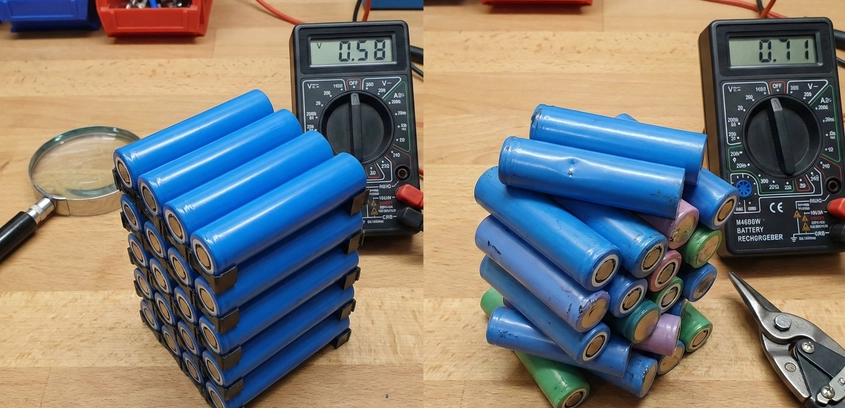
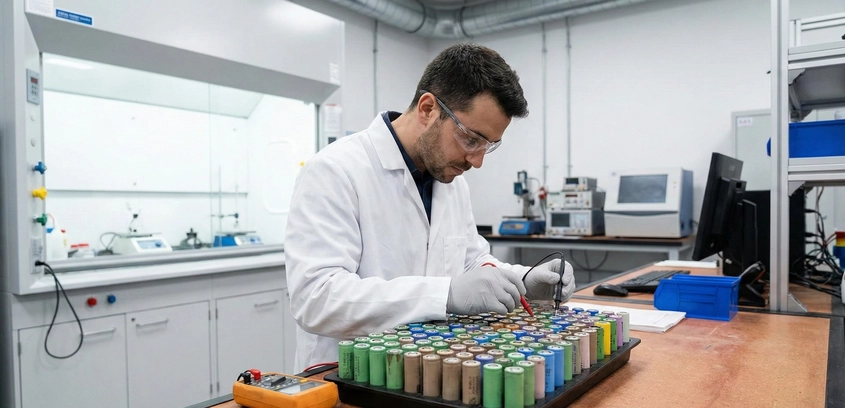
The Economics of HarvestingA new Samsung 35E cell costs $5. A used one recovered from a modem battery backup might cost $0.50 or even be free. When building a 14kWh Powerwall requiring 1,000 cells, the difference is $5,000 vs. $500. This economic reality drives the recycled cell market.However, used cells are a mystery. You don't know if they were abused, overheated, or left at 0V for a year. Using them requires a shift in mindset from "Assembler" to "Quality Control Engineer."1. The Golden Rule: The 2.0V CutoffWhen you crack open a used laptop battery, measure the voltage of every cell immediately. If a cell is below 2.0V, throw it away. Do not try to revive it. Do not "slow charge" it. Recycle it.The Chemistry of Why: When a lithium cell drops below roughly 2.0V-2.5V (depending on chemistry), the copper current collector on the anode begins to dissolve into the electrolyte. When you recharge it, that copper plates back out as conductive shunts (dendrites). These shunts create a "soft short" inside the cell. It might charge up fine today, but next week it could spontaneously heat up and catch fire. It is never worth the risk.2. The Processing WorkflowTo safely use recycled cells, you must put them through a 4-stage filter.Stage 1: Visual InspectionDiscard any cell with: - Rust: Especially on the positive vent cap (CID area). - Dents: Any deformation on the can or the negative rim. - Leaks: Any smell of strawberry/solvent or oily residue. - Heat Damage: Melted shrink wrap or scorched insulators.Stage 2: Charge and Capacity TestUsing a Cell Grading Charger (like an Opus BT-C3100 or MegaCellMonitor), charge the cell to 4.2V and run a discharge test. Write the measured capacity (mAh) on the side of the cell. Threshold: Generally, discard anything with less than 70-80% of its original rated capacity. If a 3000mAh cell tests at 1500mAh, its internal chemistry is degraded and will likely have high resistance.Stage 3: Internal Resistance (IR) CheckCapacity isn't enough. A cell might have high capacity but high resistance, meaning it will get hot under load. Measure every cell with an AC IR meter (YR1035+). Rule of Thumb: - Power Cells (Heaters/Tools): Keep if < 30mΩ. - Energy Cells (Laptops): Keep if < 60mΩ. - Anything > 80mΩ is trash for a powerwall. It creates a bottleneck.Stage 4: The Heater Test (Self-Discharge)This is the most critical safety step. 1. Charge all passed cells to 4.20V. 2. Let them sit on a shelf for 30 Days. 3. Measure voltage again. Pass: > 4.10V. Fail: < 4.00V.A cell that drops voltage by itself has internal micro-shorts. If you put this "Heater Cell" into a parallel group, it will constantly drain its neighbors, pulling the whole pack down and generating heat. These are the cells that kill Powerwalls.3. Binning and Pack BuildingOnce you have your verified good cells, you must "Bin" them. Group them by capacity (e.g., 2000-2100mAh pile, 2100-2200mAh pile). When building series connections, every parallel group must have the same total Amp-hour capacity. Mixing a 20Ah group with a 30Ah group in series will cause the BMS to cut off early, wasting the capacity of the larger group.4. C-Rating LimitationsRecycled cells are tired. Their internal resistance is higher than new cells. Never use recycled cells for high-drain applications like E-bikes, Skateboards, or Drones. The voltage sag will be terrible, and they will overheat. Only use them for low-drain applications like Solar Powerwalls (0.2C discharge or less) or USB power banks. In a massive powerwall (e.g., 80 cells in parallel), the load per cell is tiny, which is the perfect retirement home for these aging veterans.5. The Fuse Wire DebateWhen building with recycled cells, you should fuse at the cell level. Instead of spot welding nickel strips directly, many builders use a thin fuse wire or glass fuse to connect each cell to the busbar. Why? If one recycled cell decides to short circuit internally, the other 79 cells in the parallel group will dump their energy into it instantly. A cell-level fuse will blow, isolating the bad cell and preventing a thermal runaway event. This is non-negotiable for safety with second-hand lithium.

14 Sep 2025 Read More
Solid State Battery Progress Cell Types & Chemistry

Solid State Battery Progress

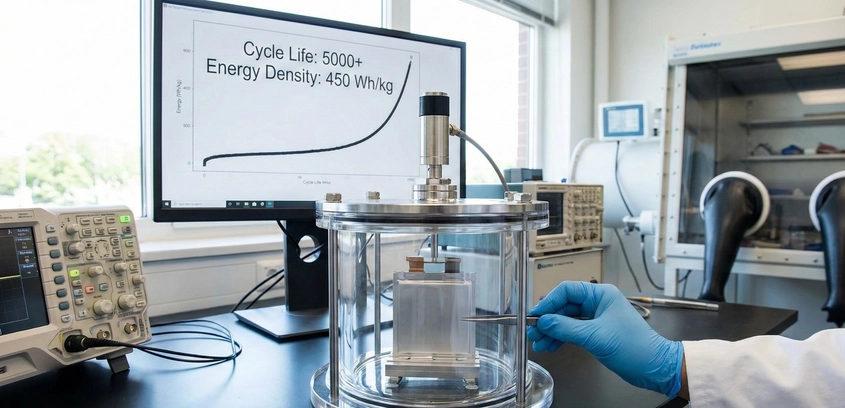
The End of the Liquid Era?For over three decades, the Lithium-Ion battery has remained fundamentally unchanged in its basic architecture: a cathode, an anode, and a liquid electrolyte separator that allows ions to swim between them. This liquid electrolyte is the Achilles' heel of modern batteries. It is volatile, flammable, and imposes a strict speed limit on charging.Enter the Solid State Battery (SSB). By replacing the liquid solvent with a solid ceramic or polymer electrolyte, engineers promise to solve the three biggest bottlenecks of energy storage: Safety, Density, and Charging Speed. But if the technology is so superior, why aren't we driving solid-state cars today? The answer lies in the brutal physics of solid-to-solid interfaces.1. The Chemistry: Why Solid State WinsTo understand the hype, we must look at the Anode. Current batteries use Graphite anodes because pure Lithium metal is too dangerous. In a liquid cell, Lithium metal forms mossy, needle-like structures called dendrites during charging. These needles pierce the thin plastic separator, shorting the cell and causing a fire.A solid electrolyte acts as a physical barrier—a ceramic wall—that is theoretically hard enough to block these dendrites. This allows manufacturers to ditch the Graphite anode (which is heavy and bulky) and use a Lithium Metal Anode. The Impact: Graphite holds ~372 mAh/g. Lithium Metal holds ~3,860 mAh/g. This switch alone could double the energy density of a battery cell overnight, pushing gravimetric density from 250 Wh/kg to over 500 Wh/kg.2. The Manufacturing Hell: Contact ResistanceIn a liquid battery, the electrolyte wets the electrodes. Ideally, it soaks into every microscopic pore, ensuring perfect contact for ion transfer. In a solid-state battery, you are trying to press two solids together (the electrode and the electrolyte). Imagine pressing two rocks together; they only touch at the high points. The gaps between them create massive Interface Resistance.To solve this, researchers have to apply immense pressure to the cell stacks or use softer polymer electrolytes. However, polymers are less conductive than ceramics. This trade-off between conductivity (power) and manufacturability is currently the biggest hurdle scaling from lab coins to EV-sized packs.3. The "Semi-Solid" BridgeWhile we wait for true ceramic SSBs, a hybrid technology has emerged: Semi-Solid or "Condensed" batteries. Companies like NIO, WeLion, and CATL are leading this charge.These cells use a gel-like electrolyte infused into a solid matrix. It is not fully dry, but it is much safer and denser than traditional liquid cells. Current Status: 150kWh packs are already shipping in luxury EVs in China, boasting 360 Wh/kg. This is the technology that will likely dominate the high-end market for the next 5-7 years before true solid-state matures.4. Safety: The Fireproof PromiseLiquid electrolytes are essentially gasoline. They are organic solvents that burn violently. Solid ceramic electrolytes are non-flammable. If you puncture a solid-state cell, there is no liquid to leak out and no volatile solvent to ignite. While the lithium metal anode itself is reactive, the absence of the flammable transport medium drastically reduces the risk of Thermal Runaway. This could theoretically eliminate the need for heavy steel armor plates and complex cooling systems in EVs, further increasing range.5. The Timeline for DIYersWhen can you buy a 21700 Solid State cell for your e-bike?2024-2026: Initial rollout in luxury EVs ($100k+ cars). Technology is proprietary and expensive.2027-2029: Expansion to consumer electronics (phones/drones). This is usually where DIYers get their first taste via salvaged parts.2030+: Mass commoditization.For now, the technology is too expensive (~$800/kWh) compared to the plummeting cost of LFP (~$60/kWh). Unless you are building an electric aircraft where weight is the only metric that matters, standard Li-Ion remains the king.6. Dendrites are StubbornRecent research has shown that lithium dendrites are more powerful than we thought. They can actually crack ceramic electrolytes by growing into the microscopic grain boundaries (cracks) of the material. This has tempered the early enthusiasm. Manufacturers are now developing multi-layer separators (a soft polymer sandwiching a hard ceramic) to mitigate this mechanical stress.SummarySolid State is not vaporware; it is inevitable. But it is an evolutionary step, not magic. For the next decade, the battery market will likely split: LFP for stationary/budget applications, and Solid State for performance/aviation. Don't pause your current build waiting for this tech; build with what is proven today.

13 Sep 2025 Read More
How to Read Battery Datasheets: Samsung 25R vs. 30Q Cell Types & Chemistry

How to Read Battery Datasheets: Samsung 25R vs. 30Q

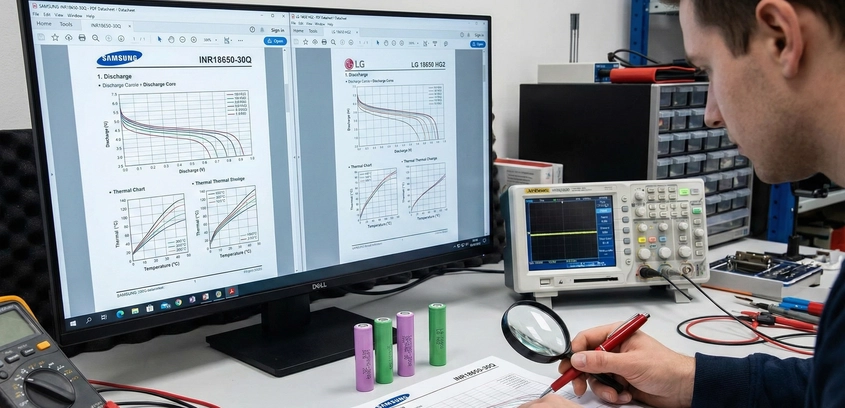
Don't Trust the Wrapper, Trust the PDFWhen you buy a battery, you are buying a set of chemical promises. These promises are codified in the Manufacturer's Datasheet. Yet, most DIYers never read them. They rely on vendor claims like "3000mAh" or "35 Amp Discharge."To illustrate the nuance of cell selection, we will compare two of the most popular 18650 cells in history: the Samsung INR18650-25R (The Power Cell) and the Samsung INR18650-30Q (The Hybrid Cell). By the end of this guide, you will know exactly why one is better for a drill and the other for an e-bike.1. Nominal vs. Minimum CapacitySamsung 25R Datasheet: - Nominal Capacity: 2500mAh - Minimum Capacity: 2450mAhSamsung 30Q Datasheet: - Nominal Capacity: 3000mAh - Minimum Capacity: 2950mAhLesson: Manufacturers grade their cells. "Nominal" is the average. "Minimum" is the guarantee. If you test a new 30Q and get 2960mAh, it is not defective; it is within spec. Testing Condition: Note that these capacities are measured at a standard discharge rate (usually 0.2C) down to 2.5V. If you stop at 3.0V (common for BMS), you will measure ~5% less capacity. This is normal.2. Max Continuous Discharge Current (The Heat Limit)This is the most critical safety section. 25R Rating: 20A Continuous. 30Q Rating: 15A Continuous.However, look for the fine print. Samsung often adds a caveat: "With temperature cut-off at 75°C." This means the cell can chemically output 20A, but it generates so much heat that if you don't stop when it gets hot, it will degrade rapidly. In a tightly packed battery with no airflow, a 30Q running at 15A continuously will easily exceed 75°C and cook itself. Engineering Rule: De-rate the datasheet number by 30-50% for pack usage. Treat the 30Q as a 10A cell and the 25R as a 15A cell for long-life designs.3. The Discharge Curve (Voltage Sag)Datasheets include a graph showing Voltage vs. Capacity at different loads (5A, 10A, 20A). The 25R Curve: At 20A load, the voltage stays above 3.2V for a significant time. The curve is "stiff." The 30Q Curve: At 20A load (burst), the voltage sags instantly to 3.1V. Even though the 30Q has more capacity (mAh), at high amps, the voltage sag triggers the "Low Voltage Cutoff" earlier.Result: If you are building a high-power vape or impact wrench, the 25R will actually give you more usable runtime than the 30Q, because it doesn't sag below the cutoff voltage as quickly under load. Capacity isn't everything; stiffness matters.4. Internal Resistance (AC vs. DC)25R Spec: $le 18 mOmega$ (AC 1kHz) 30Q Spec: $le 26 mOmega$ (AC 1kHz)The 25R has significantly lower internal resistance. This explains why it runs cooler. QC Tip: When you buy cells, measure them with a YR1035+ meter. If you buy "New" 25R cells and they measure 30mΩ, they are either fake, used, or old stock. The datasheet gives you the baseline for fraud detection.5. Cycle Life and "End of Life"Samsung defines cycle life at specific conditions. 25R: 250 cycles to 60% retention (at 20A discharge). 30Q: 300 cycles to 75% retention (at 15A discharge).Notice how harsh these tests are! They discharge at the absolute limit. If you use these cells gently (e.g., 5A discharge for an e-bike), you will get 1000+ cycles easily. The datasheet shows the "Worst Case Scenario."6. Standard Charge vs. Fast Charge25R Charge: Standard 1.25A / Max 4A. 30Q Charge: Standard 1.5A / Max 4A.Both cells allow a 4A fast charge, but the datasheet warns that this impacts cycle life. For longevity, stick to the "Standard" rate (approx 0.5C). Charging a 3000mAh cell at 1.5A takes about 2.5 hours. Patience pays off in longevity.Summary: Which one to pick?Choose the Samsung 25R (or Molicel P26A) if: - You are building power tool packs. - You have a high-power, short-range vehicle (skateboard). - You need minimal voltage sag at high currents.Choose the Samsung 30Q (or LG HG2) if: - You are building a long-range e-bike battery. - Your load per cell is under 10A (e.g., a 4P pack providing 40A total). - You want maximum range per kilogram.Reading the datasheet allows you to match the cell not just to the voltage of your project, but to the thermal and kinetic reality of how you will use it.

10 Sep 2025 Read More